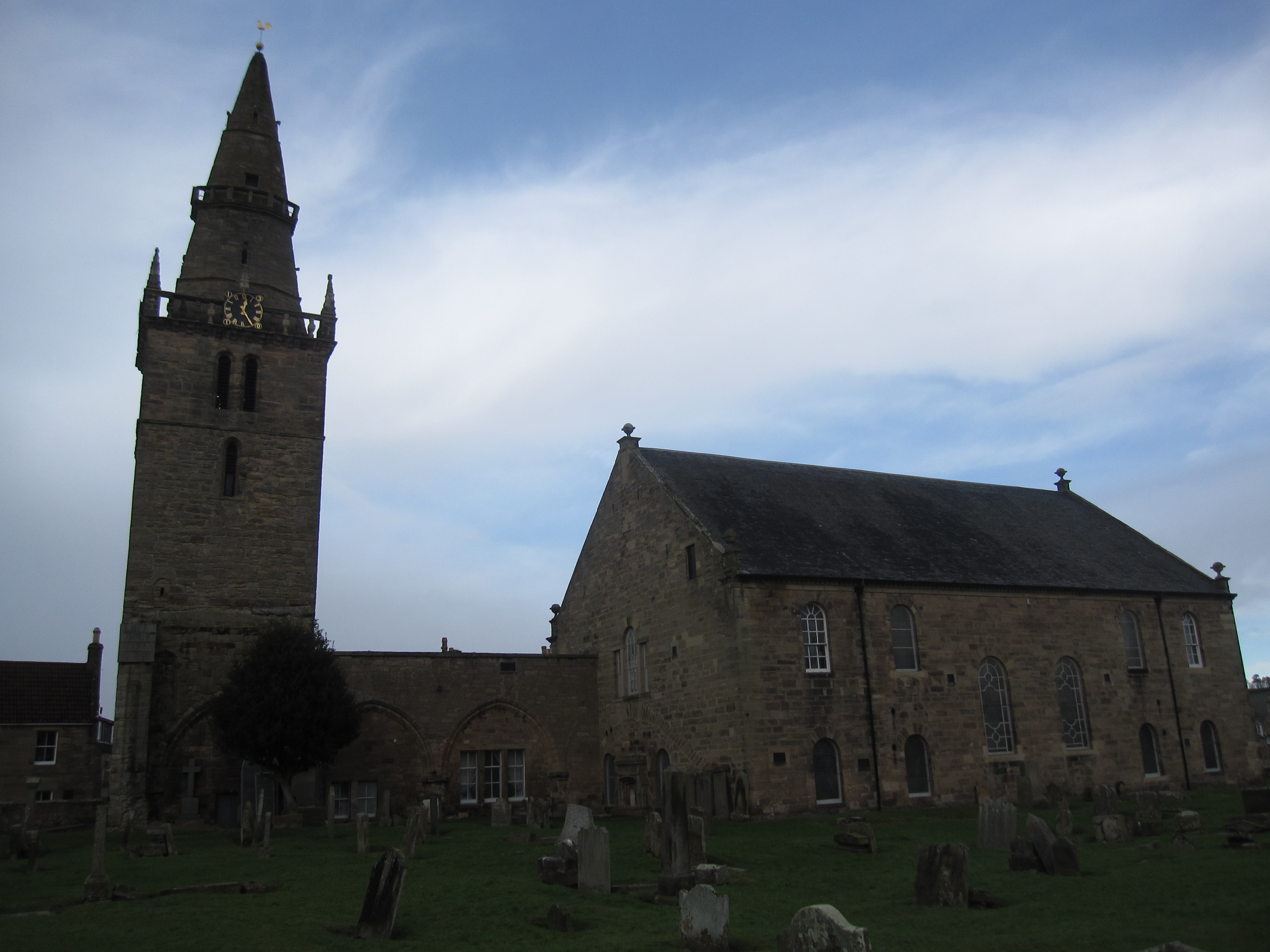
I’ve another wee book coming out soon, this time the story of Cupar Old Parish Church in Fife, which this year celebrates its 600th anniversary.
I wrote the book for them back in 2013, but the plan was always for it to be published early in 2015, and it should be launched in March. As an important Fife town in its own right, and a near neighbour to St Andrews, Cupar had many fascinating stories to uncover. It’s always interesting to see how major national and international events like the Reformation and the 17th century conflicts played out in one local situation.
Some of the research for this one involved going to St Andrews, and consulting records in the University’s Special Collections reading room – which at that time was a cramped and draughty portacabin! Since then, however, the Special Collections have moved into what used to be Martyrs’ Kirk in North Street. I worshipped there for a while when I was a student, so I’m sorry it wasn’t open yet when I was doing this work- I’d love to do some research there. It looks amazing in the image below, from the university website. I’ll just have to find a new St Andrews project!
Over 100,000 Canadian First World War service records have just been made available online. It was a thrill to discover that the Attestation Paper for Daniel Gordon Campbell is among them.
I discovered something of Gordon’s story as I carried out research for War Classics. When Christina visited Vimy Ridge in March 1919, she wrote:
My eyes had turned to the horizon again, to the heights that once were St Eloi. Someone I knew lay there, who had been a Canadian, and it was too far for me to go. I could only see the Ridge where he had been killed, and not the place where he lay.
Putting together clues from Christina’s narrative with information preserved elsewhere in the family, I was able to confirm that the ‘Canadian’ of whom she was thinking was Daniel Gordon Campbell. He had grown up near the Keith family in Caithness, attending the Miller Institute and Edinburgh University, and by the time war broke out was a lawyer living in Canada, and was engaged to be married to Louise, Christina’s sister. Louise never recovered from his death, and kept scrapbooks filled with newspaper cuttings about the Canadian action at Vimy, letters of sympathy from friends, and information about his final resting place.
Gordon’s attestation paper, which you can see here, includes a physical description. He had dark brown hair, dark complexion and brown eyes. Most strikingly he was 6 ft 6 inches tall, which sheds new light on the fact that he represented Scotland at the high jump!
From Louise’s scrapbook, photo of memorial to Canadian soldiers who fell at Vimy
Every fresh little detail makes these men real people. Gordon left no children to remember him, and I haven’t yet explored to see if there are any other family members who might have kept his memory alive. But thanks to Louise’s scrapbooks and Christina’s time in France, he hasn’t been forgotten.
I was at the opening of this exhibition last night. It’s been created by the National Library of Scotland on George IV Bridge, Edinburgh, to mark three hundred years since the Jacobite Rising of 1715.
Many people have heard about Bonnie Prince Charlie and the events of 1745, but the 1715 Rising is less well known – yet it makes just as compelling a story. The star this time is not Bonnie Prince Charlie but his father James, known as James VIII and III by the Jacobites. James was born in 1688 into a world of complex family relationships, intrigue, rivalry and betrayal, which played out on an international scale. The exhibition traces his story, focussing on his unsuccessful attempt in 1715 to win back the crowns of Scotland and England. It displays some of the remarkable documents which survive from that time, including the secret orders for the massacre of Glencoe which are mentioned in the press release. It’s not all drama and violence though – you can even play a game of Top Trumps, scoring the characters for a range of attributes including length of wig!
I was fortunate enough to be at the opening because I was involved in researching and scriptwriting the various interactive elements of the exhibition. These include an interactive family tree and timeline, and audio scripts which are spoken by key characters in the story – James, Queen Anne, George I etc. You can also listen to these on the National Library of Scotland website. I was working on this during the run up to the Independence Referendum, and it was impossible not to get goosebumps at the sense of history, and the connections between events 300 years ago and today. Professor Chris Whatley expanded on that theme as he spoke at the opening last night. Sheena Wellington, who gave an unforgettable performance of A man’s a man for a that at the opening of the Scottish parliament, sang Derwentwater’s Farewell last night, one of several Jacobite songs you can listen to in the exhibition.
Game of Crowns runs until next May. If you’re in Edinburgh, go along and have a look. It’s good to see some of the treasures held by our National Library, and together they tell a fascinating story. Towards the end of the exhibition you’ll see the baptismal certificate of James’ infant son Charles – better known today as Bonnie Prince Charlie. 1715 was not the end of the story….
Two sisters and a brother. Three contrasting experiences of peace.
Barrogill was with the army in France:
They picked the divisions for the slaughterhouse and sent them forward with no purpose and no idea save that they be decimated. If that be generalship a bairn could do better! The war dragged on and our pals died. By the end of 1918 after we had assembled the might of the world against Germany, weight and casualties told; the Hun sought an armistice: and the war came to an end.
It was through our lines, just where I happened to be, that in October 1918 the big black car with its huge white flags passed carrying the Hun delegation seeking armistice talks. And Foch was just behind us in his train. I was told by a friend who was present that when Foch read out the terms he was proposing to hand the Germans, Haig intervened saying ‘Good God, the Hun will never accept these terms.’ To which Foch replied ‘I am afraid they will.’ As indeed they did. And so the war ended. [from family archive material]
Christina was behind the lines in Dieppe:
Outside bells blared; flags flew; bands played; at every window in the Grande Rue faces looked out, laughing, crying. In the distance the ‘Marseillaise’ came rolling down and its echo ‘It’s – a – long – way – to – go.’
I stole into the Cathedral. Over the altar hung our flags, quiet and still. There was no need to wave them now. Utter quietness here and one spot of light only. In the chapel at my side lay the empty tomb and the marble watchers beside it. The figure of the risen Christ was outlined and ringed with light. Never have I seen so many candles ablaze together. Beneath Him in the darkness knelt clusters of black-robed women. Peace had come.
There were huge crowds already [at Buckingham Palace] but we were very lucky in getting up on the wall surrounding the statue of Queen Victoria. We were held up on the wall by soldiers and got a splendid view of the Quadrangle. We had only been there a quarter of an hour or so before the place was absolutely black with people so we were fortunate. General French and Townsend passed just beneath us on their way to the Palace – the police making way for them. It was grand. Then a band arrived and after half-an-hour during which everybody was cheering and waving flags and shouting ‘We want King George!’ he appeared! An Australian officer had managed somehow to get on top of the statue and he had most of the ragging. The King, Queen and Princess Mary appeared on the balcony and for fully ten minutes there was an uproar. It was grand and very, very thrilling. I shall never forget it. Then the band played first ‘Tipperary’ and everyone joined in- then ‘Land of Hope and Glory’ and ‘Keep the Home Fires Burning’. One after another of these topical songs, the crowds taking them up, and ending finally with all the allies national anthems. After that the King spoke but naturally I couldn’t hear a word – at least make out a word. I had a splendid view the whole time. [from family archive material]
Remembering also Louise Keith’s fiancé Daniel Gordon Campbell, Sandy Morrison and Willie West, who didn’t come home.
When I started work on Christina’s wartime memoir, War Classics, I didn’t know that it would end up being published in 2014, amid all the tv programmes, books and events commemorating the 100th anniversary of the outbreak of the First World War. In some ways – as you’ll know if you’ve read the book – her story will be even more relevant in 2018, when the focus of commemorations should shift to the transition from war to peace. I love Christina’s own account of Dieppe on the day peace was declared – the music playing in the streets, the rowdy, joyful army huts, the hushed stillness of the cathedral, and finally her walk down by the shore, thinking of the naval base at home in Thurso.
The shore at Dieppe
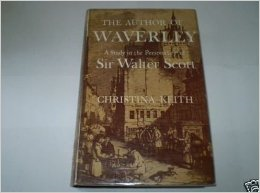
Recently, particularly here in Edinburgh, another anniversary has been marked, which also has relevance to Christina’s life and work. 2014 is the 200th anniversary of the publication of Sir Walter Scott’s first novel, Waverley. Christina’s final book was her study of Walter Scott, The Author of Waverley, which she finished shortly before she died and which Barrogill saw through publication.
The Author of Waverley: a study in the personality of Sir Walter Scott, by Christina Keith
Walk through Edinburgh’s Waverley station today – apparently the only railway station in the world to be named after a novel – and you’ll see quotes by Scott on the walls, windows and floor. These are part of a wider Great Scott! Campaign, organised to mark both the publication of Waverley and 10 years of Edinburgh’s status as the world’s first Unesco City of Literature.
There are a lot of ‘world firsts’ here, because Waverley is often said to be the world’s first historical novel. Here I should maybe confess that I haven’t actually read it. Oops. I’m doing a lot of Covenanter-related research for a new book, so have recently read Old Mortality, but I will make sure I read Waverley before the end of 2014.
This whole train of thought (no pun intended – I blame my brother-in-law) was sparked in my mind when I received an email from someone who has read War Classics, and as a result is interested in Christina’s other writing, and is now reading The Author of Waverley. I’m so pleased to think that publishing her memoir has led someone to discover Christina’s other work. And the fact that all this takes place in the 200th anniversary of the publication of Waverley just seems to be yet another of those perpetual coincidences which make exploring history such fun!
If you’ve read Faith in a Crisis, my book about the famine and evictions in 19th-century Uist, this article on the Carmichael Watson Project blog might be of interest. It has some interesting perspectives on both Finlay Macrae and Norman Macleod.
The overgrown ruins of the tacksman’s house and Finlay’s home are modest when compared with the gloomy Edwardian mansion which lies close by. Erskine Beveridge built his imposing summer home where he could enjoy spectacular views across the strand to the island of North Uist, and north towards the hills of Harris. But it was much more that simply the scenery which attracted this Fife-based businessman to Vallay.
Erskine Beveridge inherited and expanded his father’s damask linen business in Dunfermline, and made his fortune in the process. He was a keen amateur archaeologist and was very interested in the new art and science of photography. Erskine travelled widely, in Scotland, Europe, America and Canada, but in North Uist he found the ideal location to pursue these two interests of archaeology and photography. He first visited the island in 1897, and bought the island of Vallay in 1901. He then set about building a suitable house for his family – no easy task on a tidal island!
In 1911 Erskine Beveridge published North Uist: Its Archaeology and Topography, the result of his investigations on the island. Today this can be obtained in a reprint. More evidence of his time in North Uist can be found in a book recently published by RCAHMS, Wanderings with a Camera in Scotland. This wonderful book is an invaluable record of the landscape, people and architecture of Scotland in the late 19th and early 20th centuries. The North Uist photos in the collection include pictures of Beveridge’s own excavations in progresss, as well as a mixture of crofting townships and archaeological sites.
Erskine Beveridge died in 1920, and left the house to his son. But his son was tragically drowned crossing the strand in 1944, and Vallay House was soon abandoned. As each winter passes, its exposed position on the edge of the Atlantic must be taking its toll. Much of the roof and many of the floors have collapsed, and the building would be dangerous to enter. Still, there’s enough to be seen through the windows – rich red wall colouring, tiled fireplaces, even a tap – to conjur up an image of Erskine Beveridge, perhaps sitting by that fireside reading over his notes of the day, living his own island dream.
There’s much more to see on Vallay – ruined farm buildings, beautiful beaches, archaeological sites. There wasn’t nearly enough time to see it all before the tide would be rolling in again. Which just means I’ll have to go back ….
I spent last week on the beautiful island of North Uist in the Outer Hebrides. Top of the list of things to do this time was walking across the strand to the tidal island of Vallay. When we were on Uist last year the tide times were all wrong, but this year they were perfect, and the weather on the day we crossed was perfect too.
There’s something very special about a tidal island. I remember spending a few days on Lindisfarne when I was researching St Cuthbert, and being so struck by the rhythms of the place – the way the visitors empty out just before the incoming tide spills over the causeway, offering precious breathing space to those who live there and to the landscape itself.
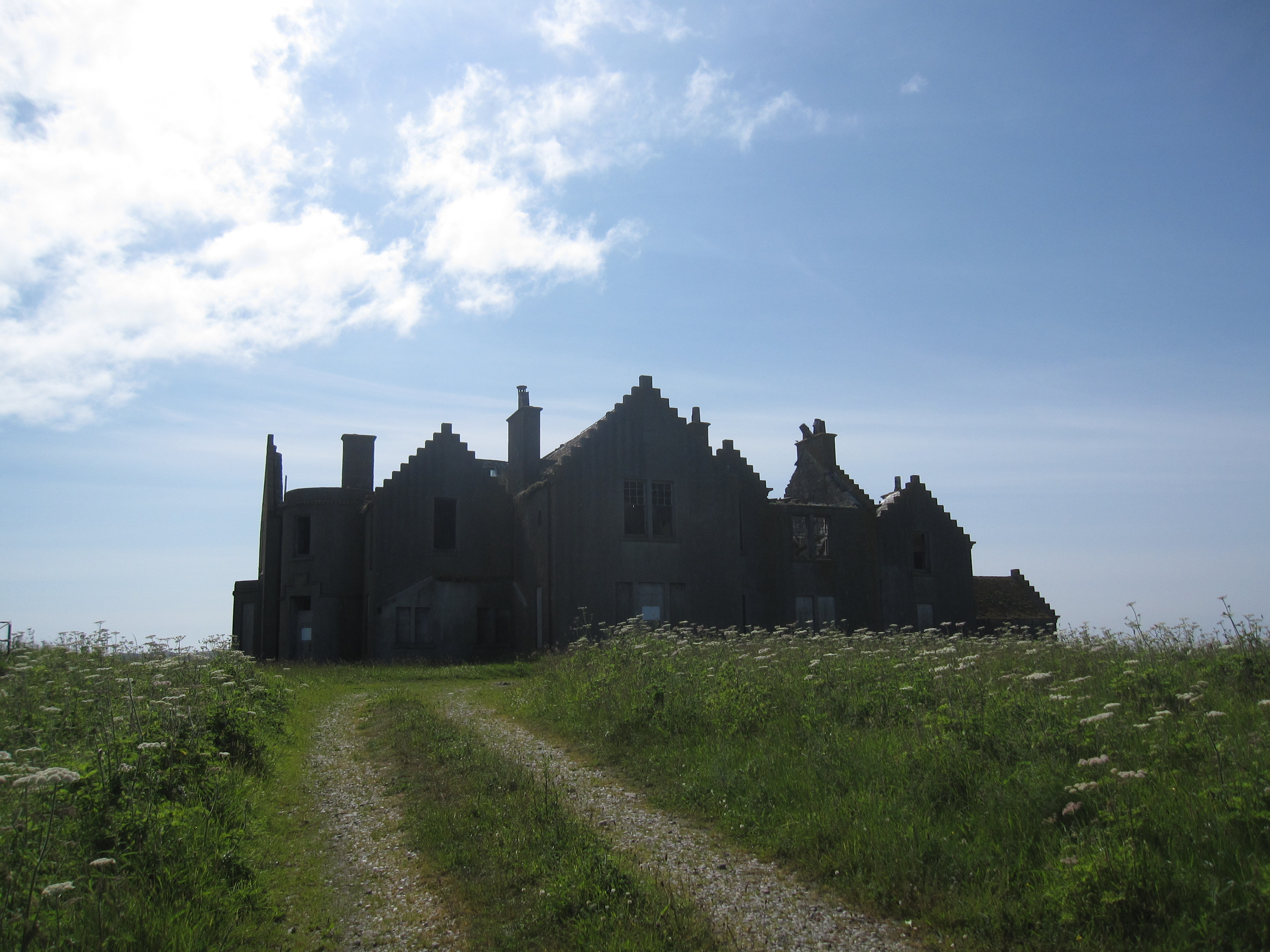
There’s no causeway to Vallay – just a vast expanse of wet sand – and there’s no one living there permanently nowadays either. But that wasn’t always the case, and the ruined houses which stand silhouetted against the skyline are a reminder of those for whom this place was once home.
In 2012 my book Faith in a Crisiswas published by the Islands Book Trust. It explores the role of the clergy during the desperate years of famine and clearance on the islands of North Uist, South Uist and Benbecula. It told the story of three men, one of whom was Finlay Macrae, minister of the Church of Scotland on North Uist. From 1825 until his death in 1858 Finlay and his family lived on Vallay.
Now stop for a moment and think of a minister being dependent on the shifting tides for access to his parishioners. Not exactly convenient! Sources agree that Finlay was very much a farmer first and a minister second, and his sermons were known as ‘the short sermons of the ebb’, as he often had to cut his service short and make a dash for home! The pastoral care of his people must also have often been dictated by the ebb and flow of the sea.
This is the house in which Finlay lived with his wife Isabella – sister of the local factor – and their children. It was said to have been built by James Gillespie Graham in the 1790s.
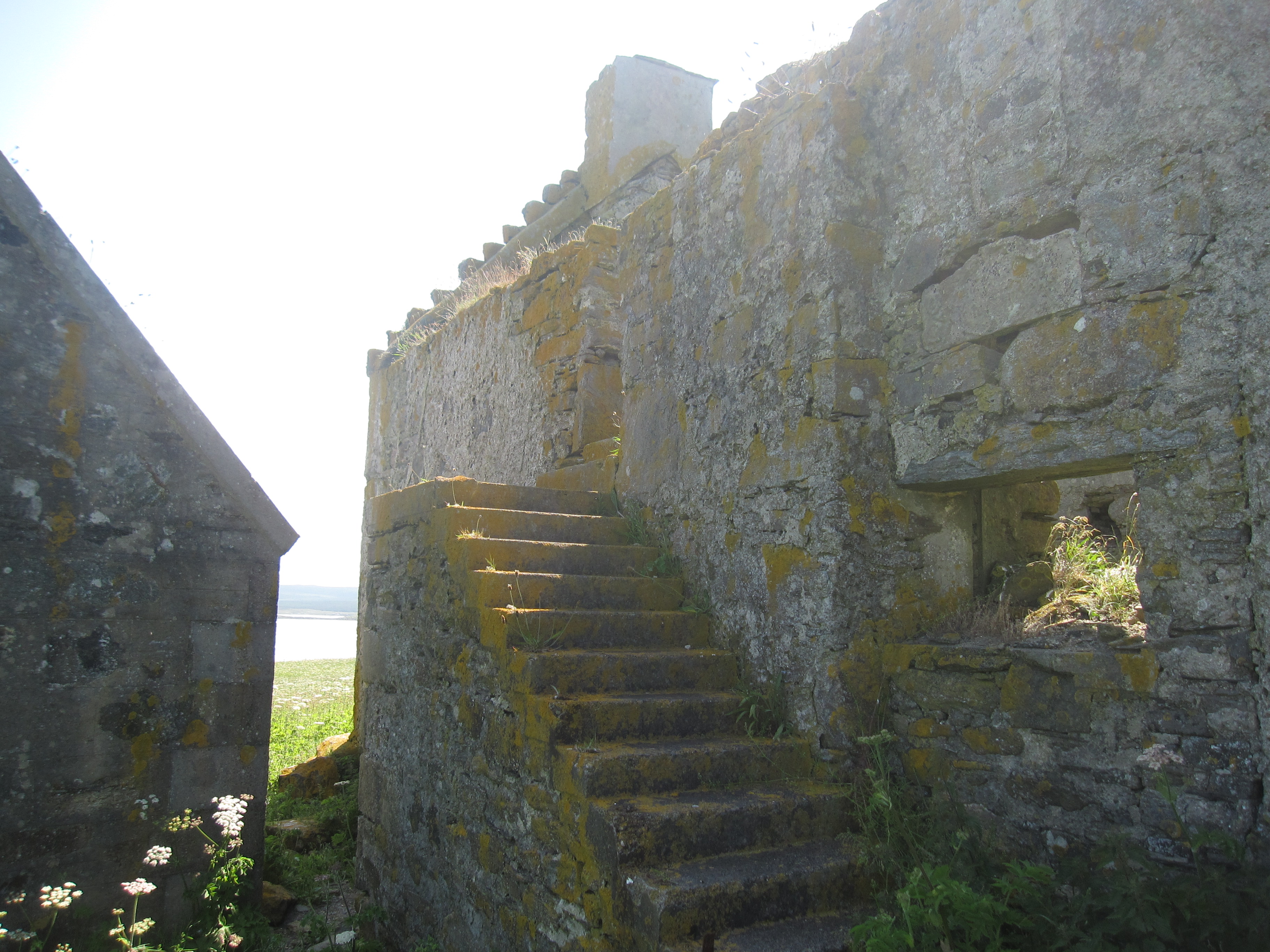
At right angles to Finlay’s house is another ruined house, known as old Vallay House, which is described on the RCAHMS website as ‘the only surviving example in the Uists of a tacksman’s house with crowstepped gables’.
It was built for Ewan MacDonald and his wife Mary MacLean, and their marriage is commemorated in a weathered lintel EMD & MML 1742.
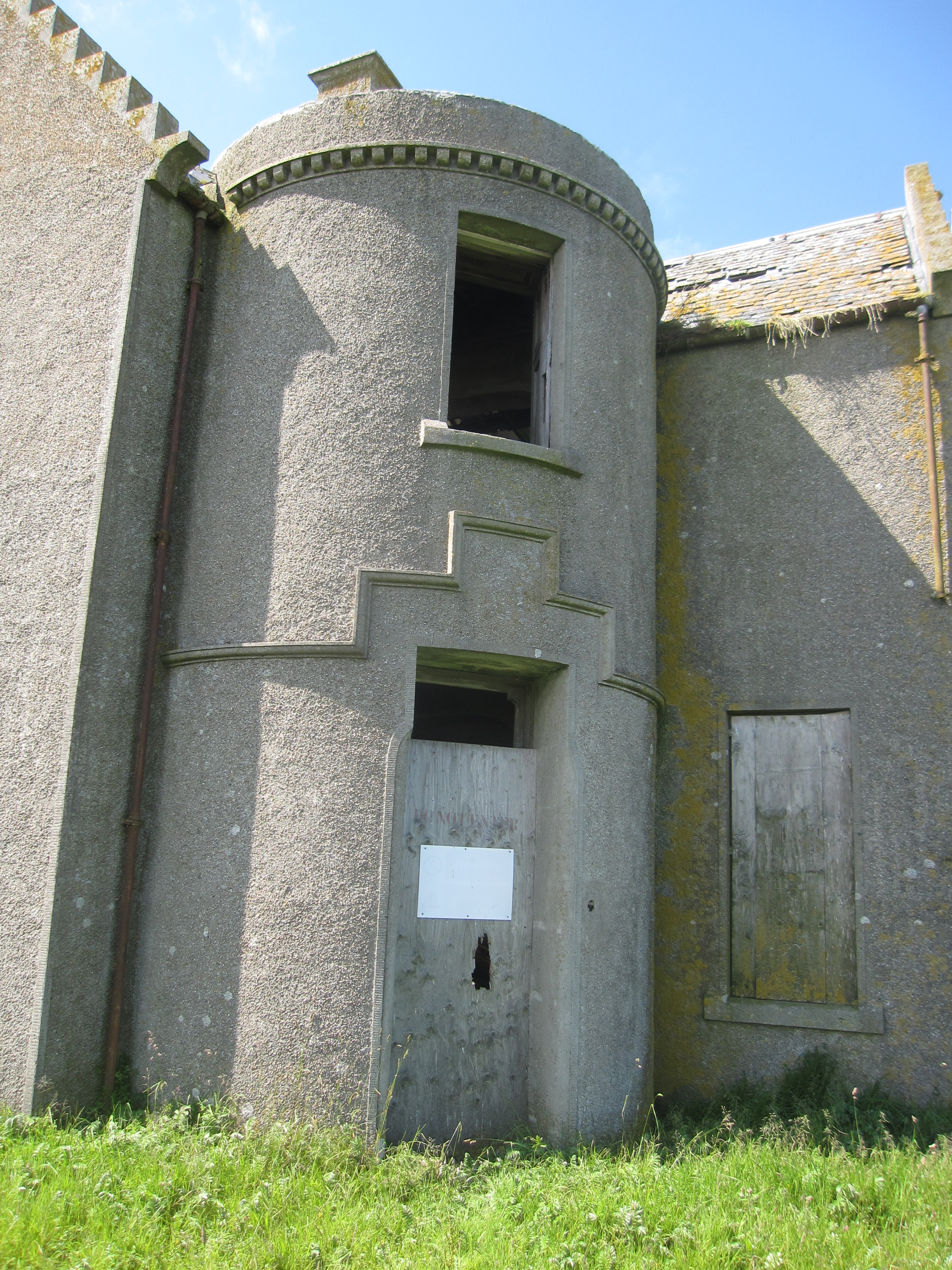
These two simple, roofless structures are overwhelmed by their neighbour. Vallay House was built around 1902 for Erskine Beveridge, linen magnate, archaeologist and photographer from Dunfermline. Although ruined, his former home still contains haunting echoes of its life as a grand Edwardian mansion.
I crossed to Vallay thinking about Finlay, and found myself becoming increasingly intrigued by Erskine Beveridge. So much so that I think he deserves a separate post. More here.
I spent today at Stirling Castle. On my own. Part proper work, part research, part sheer indulgence.
The proper work bit was to see the exhibition Wallace, Bruce and Scotland’s Contested Crown before it closes next week. It’s fun to go along and watch people interacting with the displays.
The staff were fantastic. The man who sold me my ticket told me about the special exhibition, about these documents which are ‘the oldest thing you’ll see today, older than any part of the castle’. The guide in the room was doing a brilliant job of making 700-year-old Latin texts sound interesting to a group of schoolchildren. The running totals on the ‘who would you vote for’ between Wallace and Bruce were up in the 600s, with a narrow lead for William Wallace. The exhibition was remarkably busy.
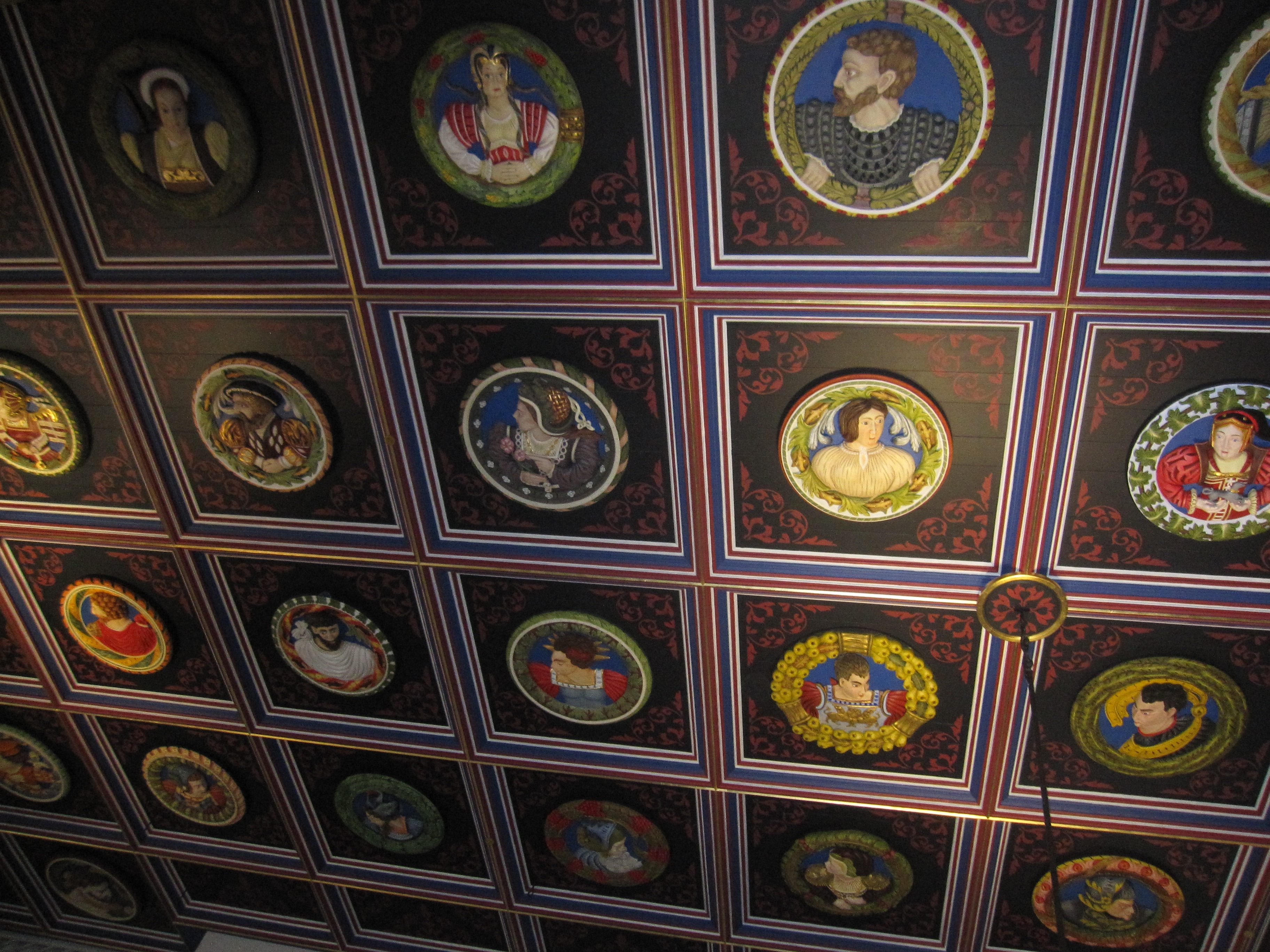
I was in Stirling Castle about twenty years ago on a Scottish History trip from St Andrews, and then again about ten years ago. But so much restoration work has been carried out on these magnificent Stewart buildings that it was well worth another visit. It’s fabulous to see the coloured reconstructions of the Stirling heads, and so much more. I love to think that many of these depict the men and women of James V’s court – it’s like having the pictures in Hello spread out across the ceiling!
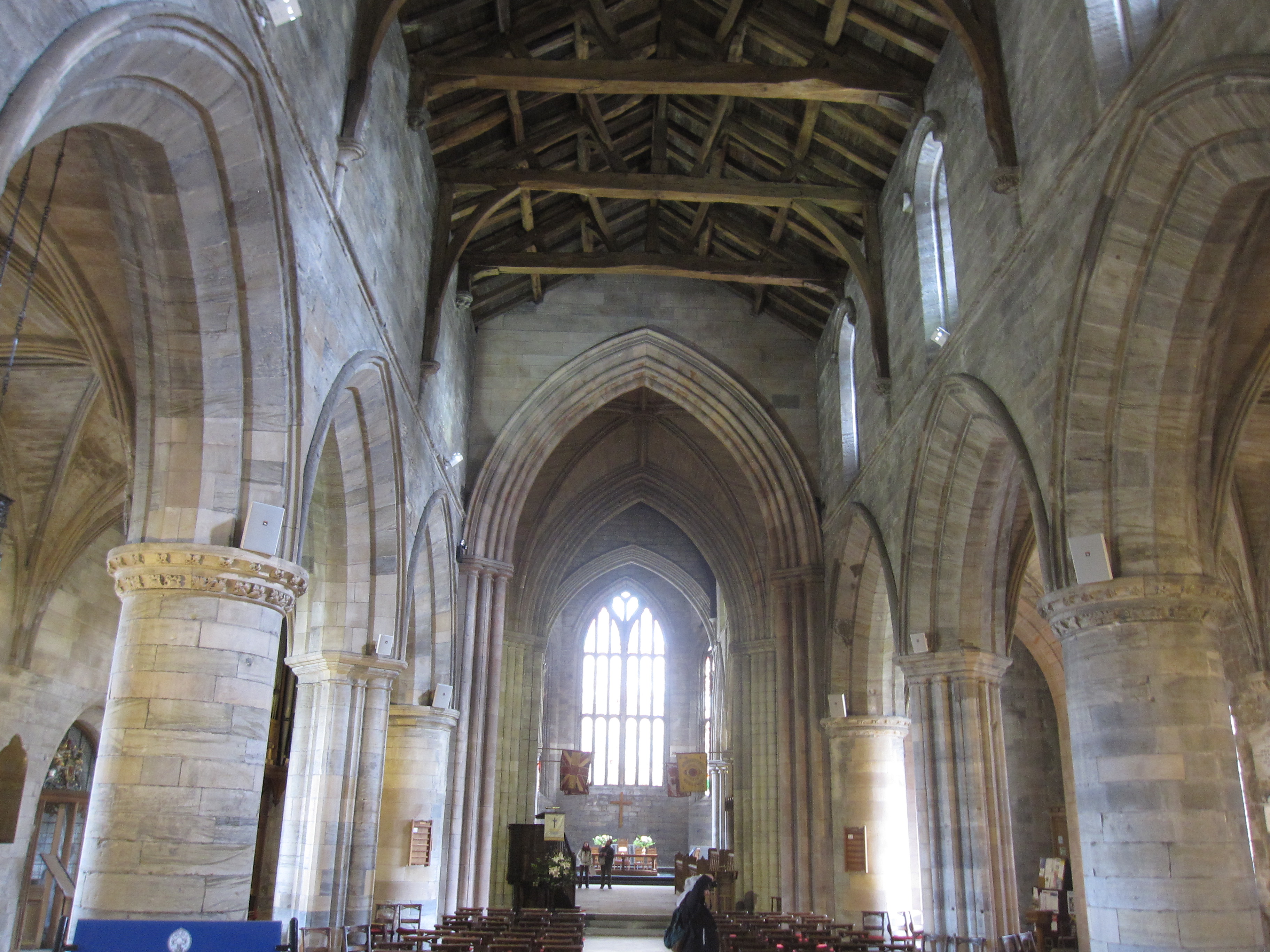
I wandered down the hill to the Church of the Holy Rude, which I’m not sure I’ve ever visited before but I particularly wanted to see today – that was part of the ‘research’ bit.
The infant King James VI was crowned here in 1567 when his mother Mary Queen of Scots was forced to abdicate.
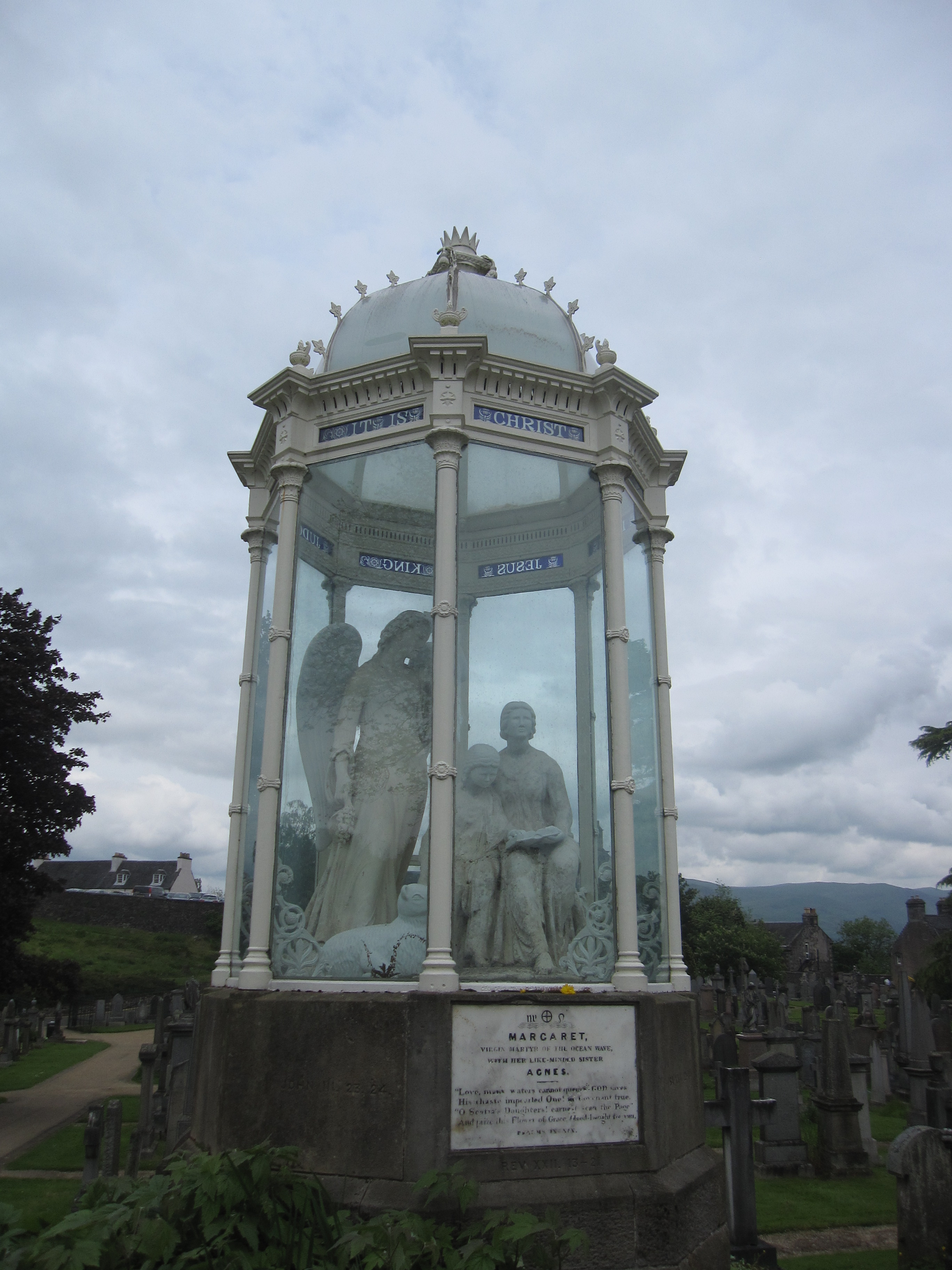
Behind the church is a graveyard which was partly laid out by the Victorians, and has some rather unexpected statues of figures from Scottish reformation history dotted around, including this truly bizarre monument to two famous Covenanting martyrs who were drowned in the Solway.
There’s a small hill in the graveyard. Climb that hill and look around, and you really are in the heartland of Scotland’s history. The surrounding landscape has been fought over again and again – Stirling Bridge, Bannockburn, Sauchieburn ….. The castle of the Stewart kings looms high, not just a strategic fortress but also a self-confident expression of dynastic power and artistic ambition. The medieval church has its own story to tell through the centuries, and then there are those figures of the Scottish reformation, interpreted through Victorian eyes. Whistlestop tour through the centuries!
Yesterday I found this wonderful article about Christina from when she was 14 years old. It must have been published c1903, probably in the Caithness Courier or John o Groat Journal, although the clipping doesn’t give a source. I love the picture, from the days when it was too expensive to take a photograph for a short piece on schoolgirl prizes.



 Barrogill was with the army in France: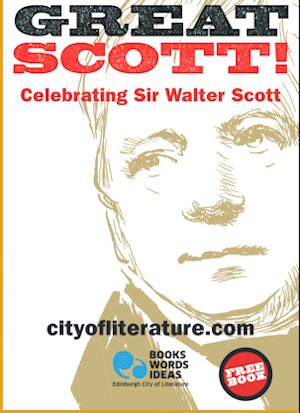









 Flora Johnston