Tag Archives: books

Exploring old Edinburgh

I like history – but I’m every bit as intrigued by the way the past connects with the present as I am by historical events themselves. That’s probably why Sackcloth on Skin isn’t the straightforward historical novel which might have more chance of finding a publisher! But they say write about what interests you, and this absolutely fascinates me. How does the past influence and intersect with the present – in ideas, in stories, in objects, in buildings? Does it matter? What if we’re completely oblivious to the history of a place or an idea – does our lack of awareness make the past irrelevant, or does it still have significance? How many layers are there anyway?

Tempting to apply that politically, but that’s not the point of this post.

One of the great things about walking about Edinburgh is that those layers of the past are everywhere around you. A new project by St Andrews University is stripping back the layers and has created a reconstruction of Edinburgh in 1544. If you like this kind of thing it’s fantastic. You can walk up the Royal Mile and through closes which are still there today, or down the steep slope of the now-disappeared West Bow to the Grassmarket.  This trailer is just a taster for the app to be released in May.

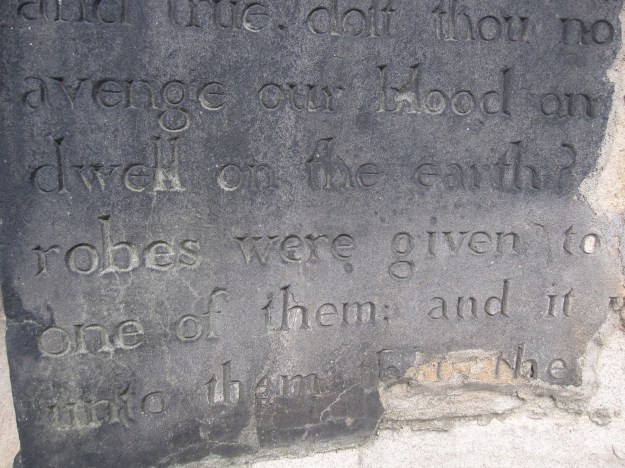
Fast forward 150 years, and Dilys Rose’s newly published novel Unspeakable conjurs up just as vivid an experience of Edinburgh’s closes, taverns and lands, this time not eerily empty but full of clamour and stink, humour, struggle and tragedy. It’s the story of Thomas Aikenhead, the last person in Britain to be executed for blasphemy. I read it with some trepidation, because when you’ve just finished your first novel you really don’t want to discover that such a superb writer is about to publish something of similar period and theme! But I really enjoyed the book, and with a deep breath can say that Sackcloth on Skin occupies its own territory. Whether that territory ever finds its way into the wider world remains to be seen…
IMG_8964

© All content copyright Flora Johnston. You may reblog or share with acknowledgement, but please do not use in any other context without permission.
 

Escape from Balranald House

IMG_8135

Balranald House

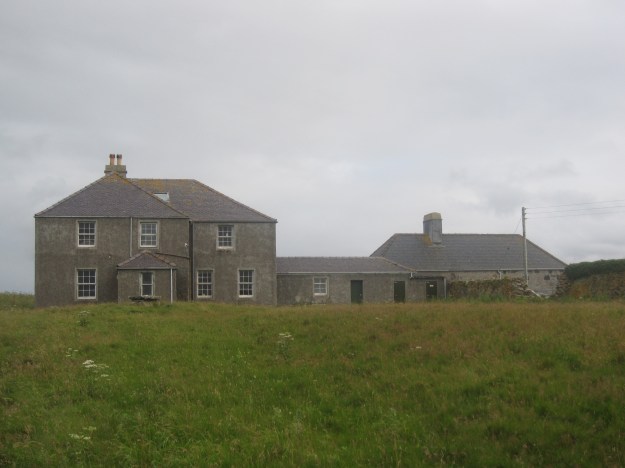
We’ve just returned from another wonderful holiday in North Uist, in the Outer Hebrides. This time the cottage we were staying in was a beautiful conversion of outbuildings once belonging to Balranald House. From one of the windows we could see Balranald House, built in 1832, which was the home of James Macdonald (also known as Seumas Ruadh), factor to Lord Macdonald.

IMG_7903

I ‘got to know’ the Macdonalds of Balranald in my research for Faith in a Crisis: famine, eviction and the church in North and South Uist (Islands Book Trust, 2012). James Macdonald was part of a close network of power and influence which profoundly affected the lives of those trying to survive on the land in Uist. His brother John lived in Rodel House on Harris and was factor to the Earl of Dunmore; his sister Isabella was married to Finlay Macrae, minister of the Established Church in North Uist who lived on Vallay (see earlier post).  I could see the ruins of Finlay’s church at Kilmuir through another window of the cottage.

In 1850, the Macdonalds of Balranald were at the heart of a romantic drama which was reported in newspapers throughout Scotland. Twenty-one year old Jessie was in love with Donald Macdonald of Monkstadt, Skye, but her father Seumas Ruadh wanted her to marry Patrick Cooper. He was an Aberdeenshire man who was trustee for the heavily indebted Macdonald estates and the main instigator of the recent Sollas evictions. A marriage to Seumas’s daughter would have further strengthened important ties.

In February 1850 Cooper proposed to Jessie. In desperation she wrote to her lover, and the two decided to elope. With the help of Donald’s servant they fled from Balranald House by night, Jessie by all accounts in high spirits all the way to Lochmaddy. But it was a stormy night, and while making for Skye they were swept off course to Harris. By this time the alarm had been raised, and they were discovered by Jessie’s uncle, John of Rodel. Jessie was taken to Rodel House where she was held captive, her aunt sleeping in the bedroom with her to prevent another escape.

Donald meantime returned to Skye, where he gathered some friends and sailed to Harris to rescue Jessie by night. Newspaper accounts state that ‘Mr Macdonald (Rodil) came out of his house in his shirt and drawers, swearing at them as if he was mad.’ Somehow, in the ensuing confusion, Jessie and Donald managed to make their escape. They fled to Edinburgh where they were later married, but Seumas Ruadh and John of Rodel, together with Patrick Cooper, were not likely to accept such defiance. Donald Macdonald was charged with breaking into Rodel House and with assault, but he was cleared – to cheers from the public gallery. The young lovers had excited public sympathy.

Jessie and Donald were married on 22 April in St Cuthbert’s parish, Edinburgh. Church of Scotland marriages required banns to be proclaimed on three separate occasions in the home parish of both bride and groom. In what may have been an attempt by Finlay to lend some belated respectability to the affair, an intriguing entry in the Kilmuir marriage register reads:

Donald MacDonald Tacksman of Baleloch to Jessie Cathrine MacDonald daughter of James Thomas MacDonald Esquire Tacksman of Balranald 31st March 1850.’

It’s interesting to notice that the very next entry in the Kilmuir register records the marriage of another Balranald daughter, Elizabeth, to a Skye minister, also in April 1850. This entry states that the banns were ‘proclaimed in the Parish Church in North Uist in the regular and normal manner’ – a statement that is not made with regard to Jessie’s marriage. No doubt Elizabeth’s wedding was a much happier occasion for the family!

Jessie and Donald eventually emigrated to Australia, but their dramatic story illustrates just how closely factor, minister and land agent were bound together at this critical time in Uist’s history, a theme which I explore in more detail in the rest of the book.

[adapted from Flora Johnston, Faith in a Crisis: famine, eviction and the church in North and South Uist, Islands Book Trust 2012]


© All content copyright Flora Johnston. You may reblog or share with acknowledgement, but please do not use in any other context without permission.

The First Post

Welcome to my new website.

The idea is to create a place where I can post updates and information about my work, particularly my writing. I have two new books in the pipeline, so it will be good to have somewhere to share information about these when the time comes.

I might blog about writing … but then again I might not.

I’ve tried to keep it simple, so hopefully you’ll get an idea of some of the other work I enjoy doing. If I can do any research, writing or editing work for you, please get in touch!

Flora x

© All content copyright Flora Johnston. You may reblog or share with acknowledgement, but please do not use in any other context without permission.