The shipwreck that never was

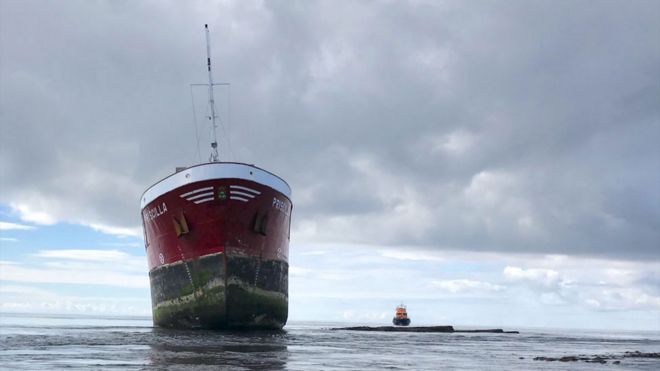
There’s a ship called the Priscilla aground in the Pentland Firth at the moment – see for example this from the BBC News website.

Aground cargo ship Priscilla

Photo from BBC News website

My dad was a great storyteller, particularly when it came to both sides of his remarkable family, the Morrisons of North Uist and the Keiths of Thurso. The news item about the Priscilla reminded me of one of his stories which he heard as a boy from his own grandfather, Peter Keith (1847-1936). It’s the story of a shipwreck in the Pentland Firth which wasn’t quite what it seemed ….

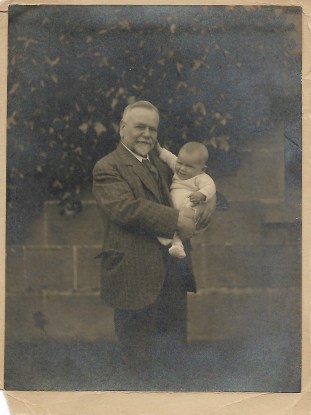
Peter Keith

Peter Keith holding his grandson Peter Keith Morrison

As a lawyer and notary public in Thurso, one of Peter Keith’s more sombre tasks was recording the circumstances of shipwrecks on the treacherous Caithness coast. On the morning after a stormy night the captain of a small sailing vessel arrived in his office, looking for a notary public who would record the sorrowful events of the night before. He told how he had tried to take refuge in the Scrabster Roads area just outside Scrabster Harbour, but his ship went down, drowning both the mate and the ship’s boy and leaving him the sole survivor.  He narrated in detail the dramatic circumstances of the shipwreck and Peter Keith made notes, then told him to come back to sign the declaration once he’d had time to write it up fully.

So far, nothing unusual. But when a second man arrived in his office, claiming to be the sole survivor of a shipwreck in Scrabster Roads, Peter Keith began to wonder. Always canny, he said nothing but let the man tell his story. This time it was the ship’s mate, claiming that both the captain and the boy had drowned, but telling a quite different tale of how the vessel came to be lost. So Peter Keith once more made notes, giving nothing away, and in time both men signed their notarial protests.

It was about a fortnight later that the true story emerged, when the twice-drowned ship’s boy turned up alive and well. The ship had indeed taken refuge near Scrabster, but once she was safely tied up and the men presumably resting, both the captain and the mate independently decided to leave the ship – completely against their duty and without the other knowing. They went ashore and spent the evening in the thick, noisy warmth of (separate) pubs.  But while they were enjoying a few stolen hours ashore of good company and fast flowing drink, sheltered from the howling winds outside, the cable holding the ship secure parted, and she began to drift out to sea once more.

233

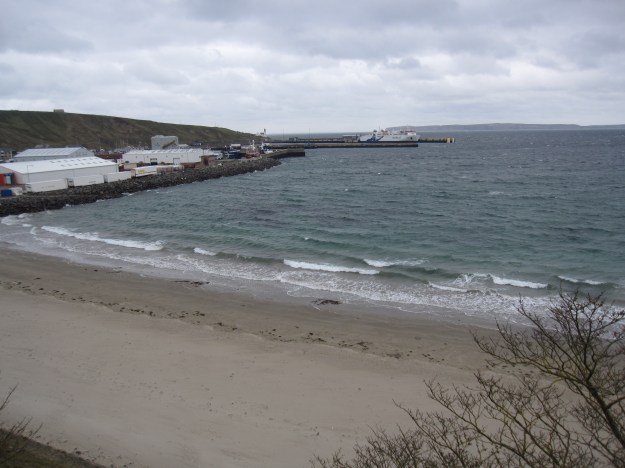
Scrabster Harbour

Eventually the captain and the mate must each have made his way back to harbour. Their ship was gone.  It was a wild night, and there seemed to be only one explanation. Each believing himself to be the only survivor, he took an invented story to the notary public to save his own skin.

And meanwhile there’s a ship adrift on that wild sea, with an inexperienced boy the only person on board.

There was a powerful west wind that night and it was blowing the ship right through the Pentland  Firth. All the poor ship’s boy knew about navigating the Firth was that ‘you sail by Dunnet Head and by Cantick Head in Orkney, and you keep the Skerry lights open’. And it may have been by skill and it may have been by chance, but he brought that ship through the Pentland Firth without disaster, and was blown right out into the North Sea. Here she was picked up by a Norwegian ship and taken in tow, and the ship’s boy eventually got back to shore.

That’s where the story ends, although of course like all good stories it leaves me wanting more. Who was the ship’s boy and what happened to him? What a story he had to tell for the rest of his life! What about the captain and the mate, what happened to them?

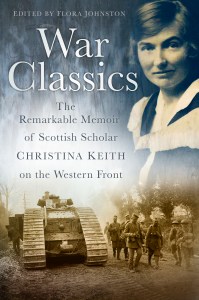
There just might be some answers. The whole story was recorded in Peter Keith’s Protocol Book. There’s a collection of Keith Family Papers in Caithness Archives which I consulted when researching War Classics, the story of Peter Keith’s daughter Christina’s time with the troops in World War One.  Among those papers is the Second Protocol Book of Peter Keith. I have no dates and no names for these events, but wouldn’t it be wonderful if the story of the shipwreck which never was appeared in some form among its pages!

© All content copyright Flora Johnston. You may reblog, retweet or share with acknowledgement, but please do not use in any other context without permission.


‘Bible Talk’ by James Robertson | The Bottle Imp

It seems a while since I put anything up here. I’ve been busy with other projects, the ‘proper work’ kind that I don’t post much about, and although I keep querying about the novel there has been very little progress over the last few months. I have one or two other ideas on the backburner, but can’t let myself focus on them until I get the current piece of work completed.

But I came across this from James Robertson, who was the guest reader at Moniack when I was there, and I wanted to share it. He’s an outstanding writer, and for me this really resonates with the thinking which led me to write Sackcloth on Skin.

‘It’s in oor banes, man.’


‘Bible Talk’

We were oot for oor usual dauner roond the toun, Tam and me, and had stopped for a pech at the tap o the hill, whaur they’re plannin tae build eichty new hooses if naebody objects, and probably even if they dae. We had got ontae the Bible, some wey or ither. “In anither thirty …

Source: ‘Bible Talk’ by James Robertson | The Bottle Imp

60 Degrees North

I read a lot of non-fiction for work, but not very often for pleasure. 60 Degrees North by Malachy Tallack was a real pleasure.

60 degrees north

There’s something about northern light and coastal communities which draws me in with a wee touch of envy. It’s a different island community which has a hold on me – North Uist to the west rather than Shetland to the north – but the themes Malachy Tallack explores as he  travels ‘around the world in search of home’ found many echoes as I followed his journey.

It’s an experience I remember from childhood, standing on white sand with my feet in icy clear water, looking to the smudged blue horizon and thinking, next stop Canada. And there’s one of the family stories right there, my great-grandfather, the restless lad who looked out on that sea and eventually used it as his means of escape, ending up in the diamond mines of South Africa. But I can’t stand on that beach and look out to sea without also being aware of what lies behind – the curve of the strand, the steep dunes and above them the mound with its leaning gravestones, the names of my forebears chiselled into stone.


Only two of my eight great-grandparents came from the island … but this is the place we went back to again and again, rather than Angus or Wester Ross or Caithness (and there’s the story of industrialisation in Scotland right there) …. so it’s the one that remains relevant in the life I live now. It’s a mix of history and memory; of family mythology and very real picnics with dark clouds racing towards us and slippery rocks underfoot. It’s caught up with a Gaelic culture my dad embraced, which has its own resonance now that he is no longer here to tell the stories he loved.

So there was a lot in 60 Degrees North which drew me in, but then it drew me on – on into the author’s journey along the 60th parallel,  from Shetland through Greenland, Canada, Alaska, Siberia, St Petersburg, Finland, Sweden and Norway.  Through the extremes of northern light and darkness, coastal communities and forests belonging to bears, he uncovers contrasting ways different communities and individuals have related and continue to relate to the landscape in which they live. What they treasure, and what they have lost. It’s a personal journey for the writer, but one written so evocatively and thought-provokingly that I kept going back to re-read and savour paragraphs again and again.

Malachy Tallack’s novel The Valley at the Centre of the World is published by Canongate in May. I’ll look out for it.

2018 reading to date (because I said I’d keep a note of it):

Swing Time, Zadie Smith
How To Stop Time, Matt Haig
The Lesser Bohemians, Eimear McBride
Room, Emma Donoghue
The Map of Love, Ahdaf Soueif
The Minister and the Murderer, Stuart Kelly
The Secret River, Kate Grenville
60 Degrees North, Malachy Tallack

© All content copyright Flora Johnston. You may reblog or share with acknowledgement, but please do not use in any other context without permission.
Shaping the Landscape Exhibition

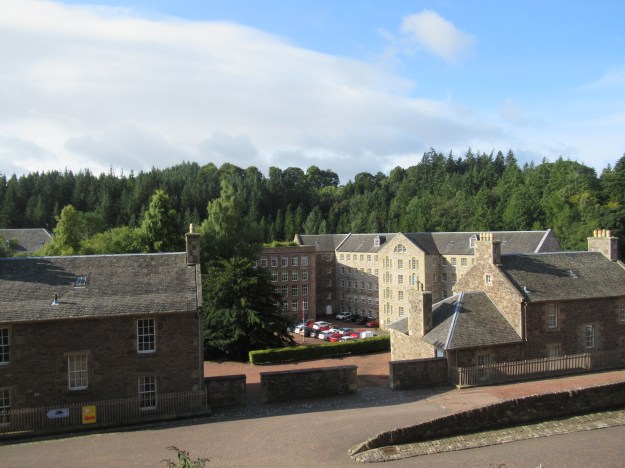
Shaping the Landscape is an exhibition currently running at New Lanark Visitor Centre. It tells the story of the dramatic geology of the Clyde and Avon valleys, and how this has influenced all aspects of life in the area. I worked on this exhibition as part of the work I do for CMC Associates, carrying out research, organising content and writing texts for display panels and digital installations.

002

New Lanark World Heritage Site

Geology may or may not be your first interest, but it’s fascinating to consider how it (literally) underlies everything else. As well as telling the geological story, the exhibition covers topics as diverse as Roman roads, Sir Walter Scott’s ‘Tillietudlem’, coal mining and ancient woodlands. It’s well worth a look if you’re in the area – and there are some stunning walks through the gorges and woodlands too.


© All content copyright Flora Johnston. You may reblog or share with acknowledgement, but please do not use in any other context without permission.


Zadie Smith, Swing Time

My one and only resolution of 2018 is to keep a note throughout the year of what I’m reading. (I could have many more resolutions, but hey, another year, same dream.)

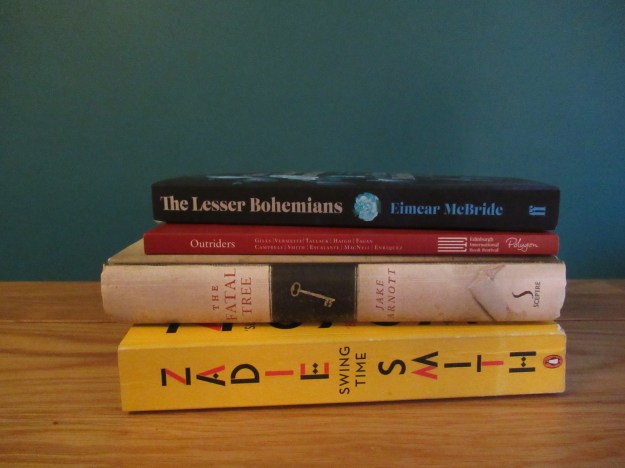
I don’t intend to share what I’m reading unless it’s of particular interest, but I’ve started the year with Zadie Smith’s Swing Time, and it’s going to be hard to beat. I was lucky enough to win it just before Christmas in a Twitter competition, along with Outriders, The Lesser Bohemians by Eimear McBride and The Fatal Tree by Jake Arnott. Thank you, Edinburgh Book Festival!

IMG_2975

I read and enjoyed White Teeth years ago when it came out, but I haven’t read anything else by Zadie Smith. That may soon change, as I loved Swing Time. I like to read a book which is not my experience yet is so convincing and so human that I can enter into that experience. And I particularly like to read a book where I’m not marvelling with every sentence and every plot twist at how wonderfully clever the writer is, because the writer has pulled me in so far that I have forgotten all about him or her – but nevertheless every now and then I’m drawn up by the beauty or poignancy or truth of what I’ve just read.  That’s what happened with this book – like this, which foreshadows #metoo so evocatively:

I remembered my own classrooms, dance classes, playgrounds, youth groups, birthday parties, hen nights, I remember there was always a girl with a secret, with something furtive and broken in her, and walking through the village with Aimee, entering people’s homes, shaking their hands, accepting their food and drink, being hugged by their children, I often thought I saw her again, this girl who lives everywhere and at all times in history, who is sweeping the yard or pouring out tea or carrying somebody else’s baby on her hip and looking over at you with a secret she can’t tell.


Next on my list is Matt Haig’s How To Stop Time which my children gave me for Christmas. I’m looking forward to it, but I always prefer to have a breather after a really good book – to stay in its world for a while before moving on. I have some research materials on standby for a possible new project, so that’s where I’ll go next.

Happy New Year!

© All content copyright Flora Johnston. You may reblog or share with acknowledgement, but please do not use in any other context without permission.
Old Lifeboat House

I researched and wrote the display boards for this project on Holy Island last year. It’s an exhibition about the history of the lifeboats on the island, with stories of dramatic rescues and the strong links with the community. Nice to see it has now opened – take a look if you’re ever on the island.


Restoring the Old Lifeboat House Holy Island.jpg

http://www.berwick-advertiser.co.uk/news/watch-the-old-lifeboat-house-on-holy-island-opens-after-1-37m-restoration-project-1-4610819

© All content copyright Flora Johnston. You may reblog or share with acknowledgement, but please do not use in any other context without permission.


Putting flesh on the bones

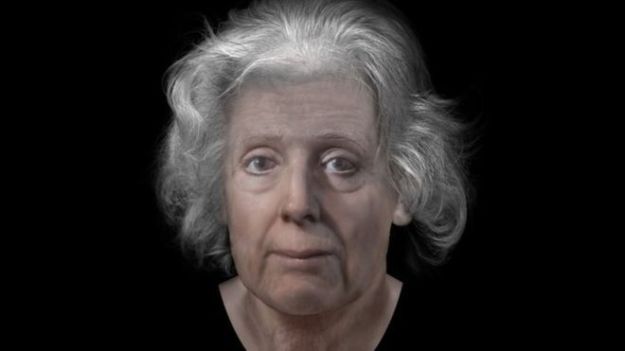
This story was on the news yesterday, timed for Halloween. Forensic artists have recreated the face of one victim of the Scottish witchhunt. Lilias died in 1704, possibly having committed suicide, after being interrogated and tortured for supposed witchcraft.

Lilias

There’s a scientific wow factor about the story, but I find it really chilling.

She’s just an old lady, somebody’s neighbour, granny. She looks like one of us. You wouldn’t look twice at her in the street. She doesn’t look like a ‘witch’, but more to the point she doesn’t look like someone from THE PAST. She just looks like one of us.

I guess that’s what as a writer I’m often trying to do. To take away the sense of the other, to reconnect with people who walked through this landscape at a different point in time.

To put flesh on bones.


© All content copyright Flora Johnston. You may reblog or share with acknowledgement, but please do not use in any other context without permission.

Longlisted for Mslexia Competition

I was really pleased and encouraged to learn that Sackcloth on Skin has been longlisted for the Mslexia Women’s Novel Competition 2017.

img_8846

Next stage is to send them the whole manuscript (hard copy rather than email – better get printing!) and the shortlist will be announced in December.

I’m sure there will be lots of high quality work on the longlist, but each result like this feels like a small step forward in trying to work out the right path for my novel, and an encouragement on the days when it all feels like a self-indulgent waste of time.

I’ll keep you posted!

Edit 9 December

I didn’t make the shortlist, which is inevitably a wee bit disappointing, but I’m still delighted that my novel was included on the longlist. Moments of encouragement and moments of despair are all part of this mix, I think! I’ll try to use them both as I work out the next steps for this book.


© All content copyright Flora Johnston. You may reblog or share with acknowledgement, but please do not use in any other context without permission.
Two men, two schools

I’ve had a really interesting piece of work over the last few years which has culminated in this little pair of booklets, available from Stewart’s Melville College.

Stewart’s Melville is an independent school in Edinburgh and a prominent landmark as you drive into town from the north along the Queensferry Road. The original building opened in 1855 as Daniel Stewart’s Hospital School, and a few years ago the school approached me to see what I could find out about the life of Daniel Stewart (1744-1814).

It wasn’t a straightforward project, with Daniel’s story surrounded in myth and lacking documentation, but the picture emerged of a young man who pulled himself out of poverty to take his place in Edinburgh’s Enlightenment society.

In 1972 Daniel Stewart’s combined with Melville College, creating Stewart’s Melville College. The founder of the other half of the school was not, as you might expect, Mr Melville. Melville College was named after the street in which it was located, and its founder was Rev Robert Cunningham (1799-1883). The natural next step was to explore his life story also. Having researched Daniel Stewart, where sources were sparse and legends plenty, this was a very different project, with vast amounts of written material available.

It was also bittersweet as my father, who passed away earlier this year, was educated at Melville College and would have been very interested in the life of its founder, particularly as they spent their early years just a few miles (and more than 100 years!) apart.

Daniel Stewart and Robert Cunningham were very different men, one shrewd and determined, the other visionary and restless. And yet there are similarities too. Both men overcame challenges in their early years: Daniel Stewart was born with few prospects, and Robert Cunningham had to give up his studies to find work when his father was lost at sea. There’s much more that could be said about their contribution to education within the Scottish context, but ultimately both men looked beyond themselves and their own needs to provide education for others.

Stewart’s Melville College is open on 23 September for Doors Open Day – why not take a look?


© All content copyright Flora Johnston. You may reblog or share with acknowledgement, but please do not use in any other context without permission.
The False Men by Mhairead MacLeod

Here’s an interesting new book.

the false men

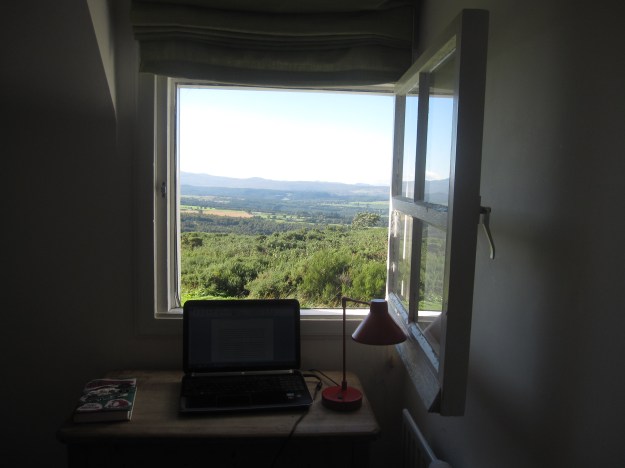
In North Uist last summer we stayed in a lovely cottage which was a converted outbuilding of Balranald House, the former factor’s house. From one window we could see Balranald House, and from another the ruins of Kilmuir Church. It thrust me back into the world I had first explored while writing Faith in a Crisis: the tightly knit network of factor, minister, agent and landlord which so profoundly affected the lives of the Uist people during the crisis years of famine, eviction and emigration in the mid-19th century.

It’s been interesting over the years too to notice that the posts I’ve written about these people and events – Escape from Balranald House and Vallay: ruined houses and a tidal island, for example – consistently receive among the most hits on this website.

The dramatic story of the elopement of Jessie MacDonald of Balranald plays out against the harsh background of famine and eviction, and involves all the key players in that tight network of relationships. ‘The False Men’ by Mhairead MacLeod, published this week, is a novel based on those events.

It feels a bit like stumbling on a novel written about people I know, so close did I get to Finlay Macrae, James MacDonald and the rest over the time I was working on Faith in a Crisis. It will be interesting to see how someone else has interpreted them!

That’s my weekend reading sorted.


© All content copyright Flora Johnston. You may reblog or share with acknowledgement, but please do not use in any other context without permission.