You can read my latest newsletter here. Subscribe to receive this straight into your inbox.

You can read my latest newsletter here. Subscribe to receive this straight into your inbox.
What’s the best way to keep in touch with you, readers?
I’ve been thinking about this for a while, given the unpredictability of social media, and so in January 2026 I will launch a monthly newsletter.
Subscribe here to receive the very first one!

I’ll use this space to share some of the challenges and joys of my writing life, and to keep you up to date with publication news. Each month I’ll have a wee Something from Scotland segment too, because why wouldn’t I want to share the stories, culture and landscape of the amazing country where I’m lucky enough to live?
See you in January.
Flora x


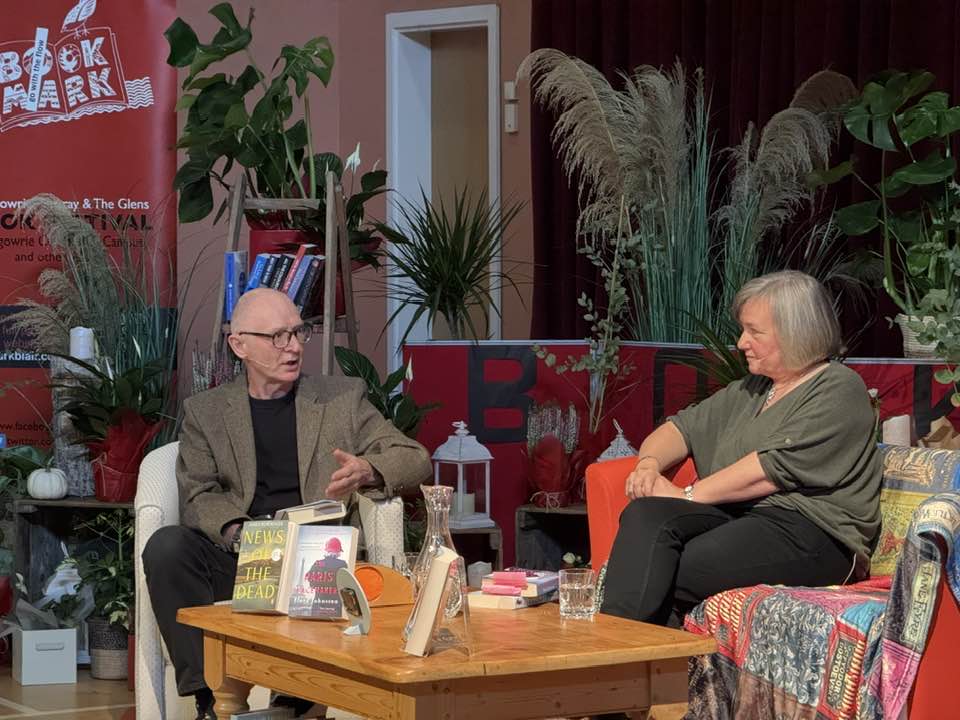
What a surprise and delight it was to be awarded the Bookmark Blairgowrie Festival Silver Bookmark for Book of the Year for The Paris Peacemakers.
Bookmark Blairgowrie is a wonderful festival, so welcoming and with really interesting speakers. I enjoyed my session chatting for an hour with James Robertson all about historical fiction, and the audience seemed to enjoy it too. It was then an unexpected thrill to be awarded this lovely silver bookmark, made by Sarah Cave silversmith, for The Paris Peacemakers.
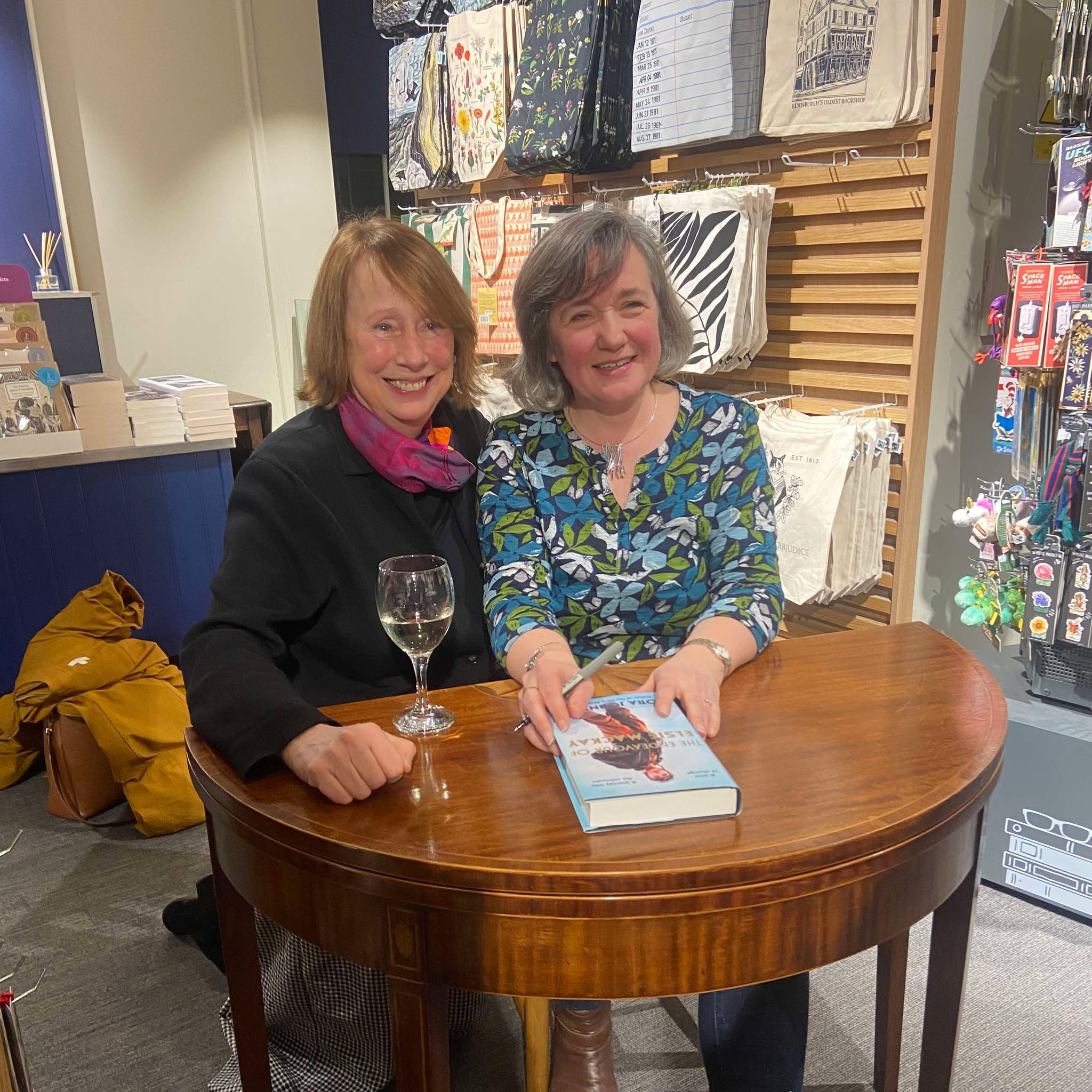
We had a lovely evening in Blackwell’s Edinburgh launching The Endeavour of Elsie Mackay! Thank you to everyone who came along, and particularly to Matthew Land for hosting and Jenny Brown for chairing.
The Endeavour of Elsie Mackay is available from publisher Allison and Busby and from all good bookshops.


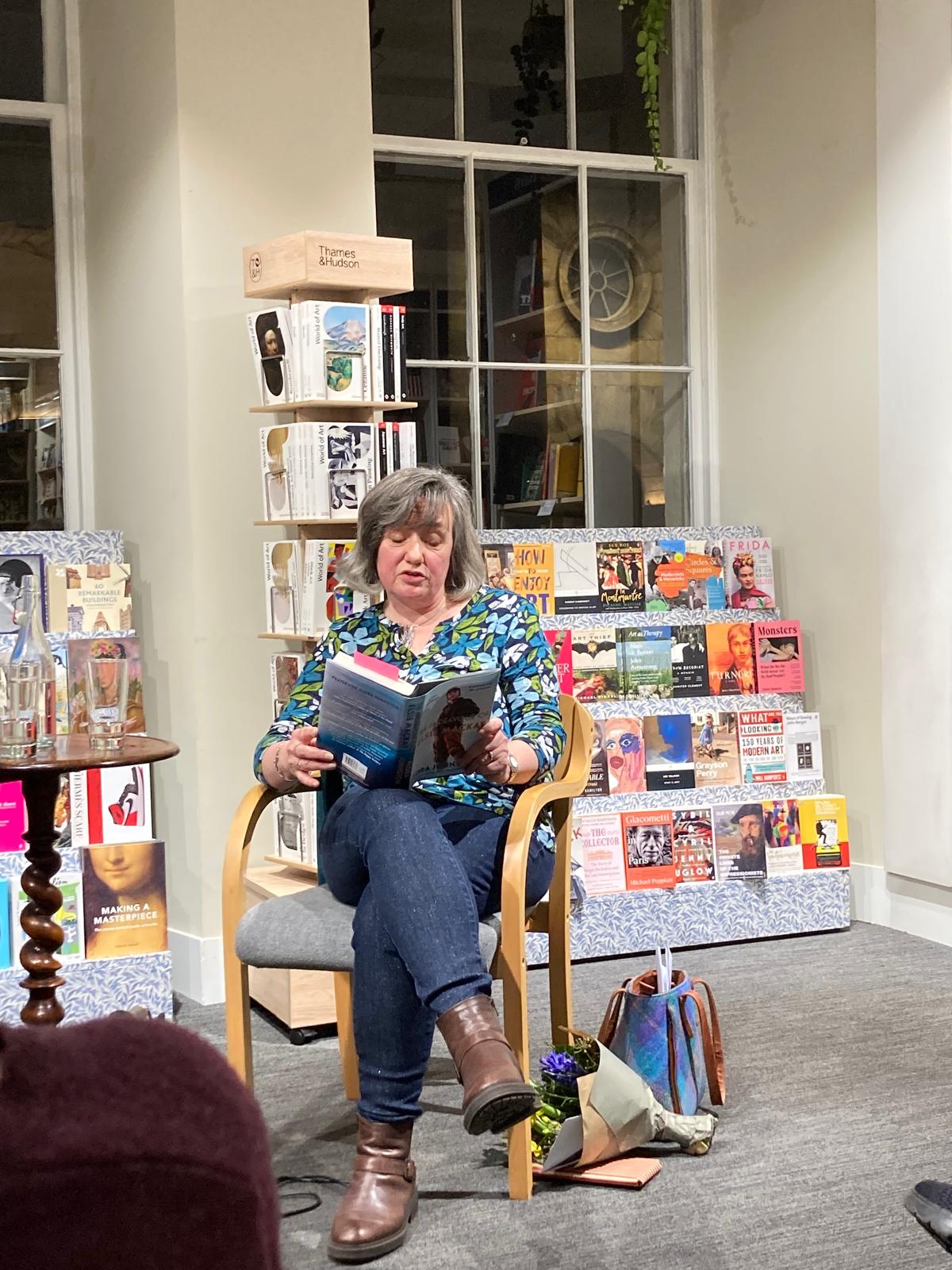
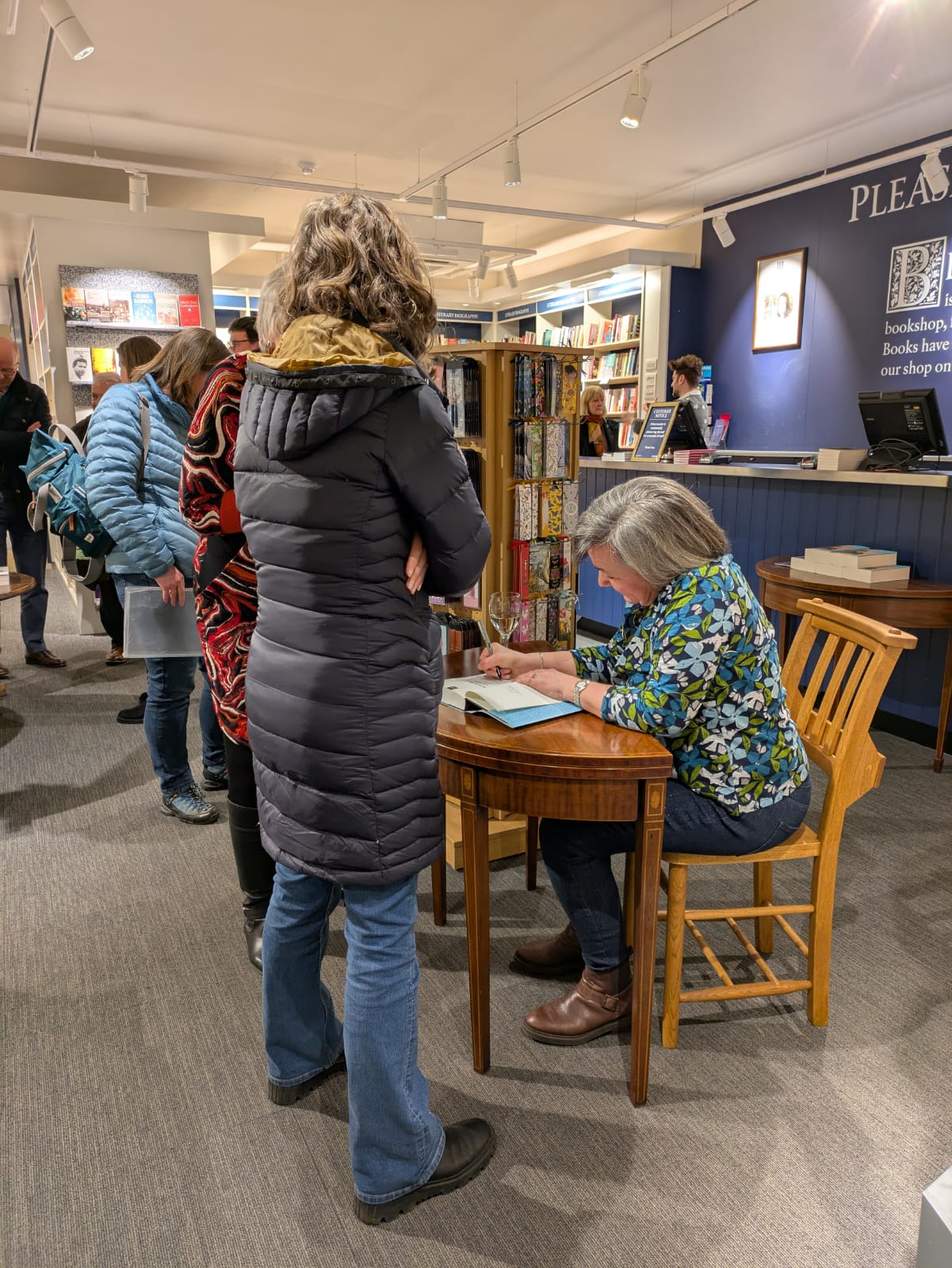
Come along to Blackwell’s in Edinburgh on Wednesday 5 February for the launch event for The Endeavour of Elsie Mackay. I’ll be chatting with Jenny Brown about Elsie’s amazing story and what came next for Corran, Stella and their families. Come and join us!
Tickets from https://www.eventbrite.co.uk/e/flora-johnston-the-endeavour-of-elsie-mackay-tickets-1200258538599
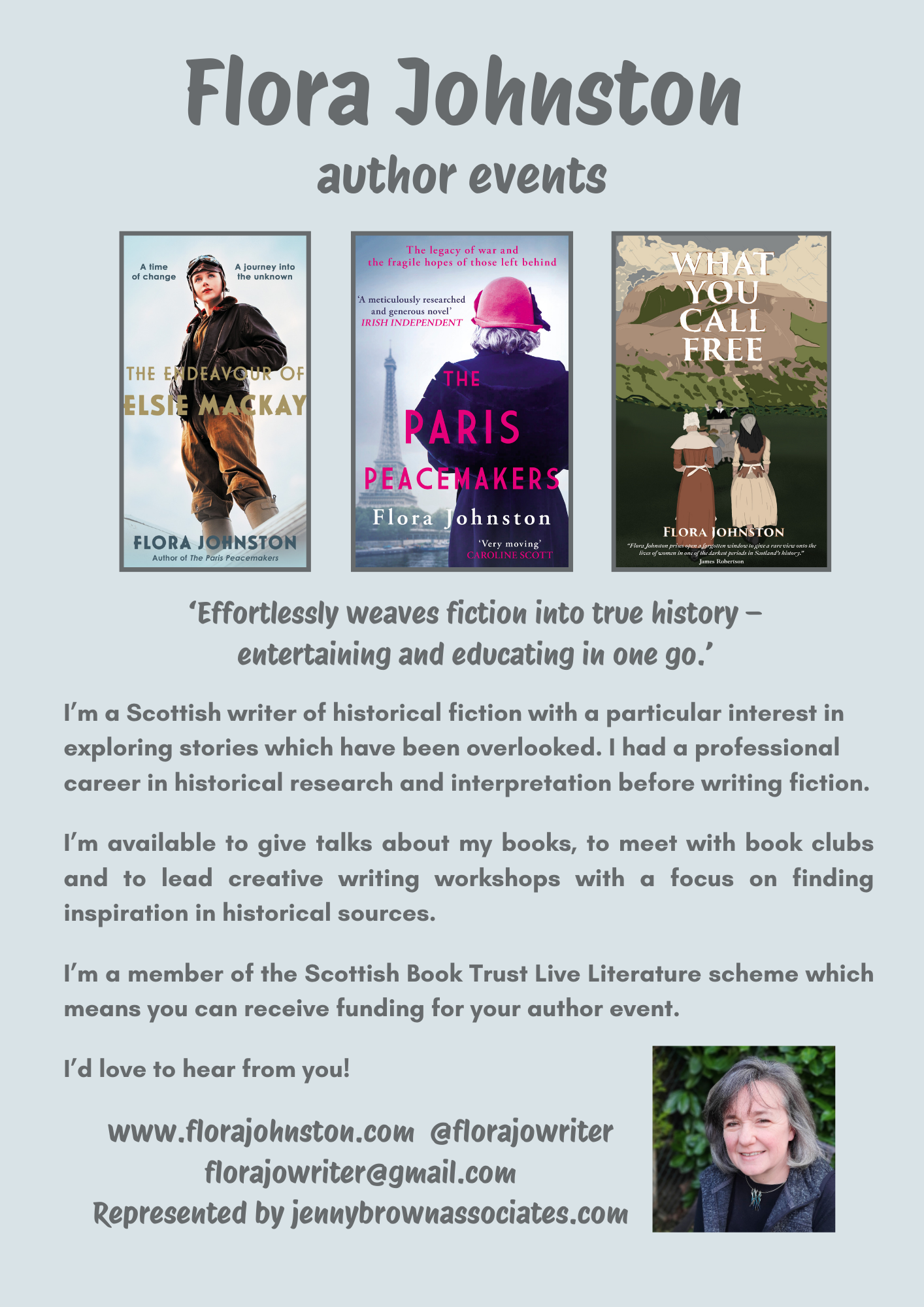
I’m delighted to be able to share news of my new novel, The Endeavour of Elsie Mackay, which will be published by Allison and Busby on 23 January 2025 and is available to pre-order now!
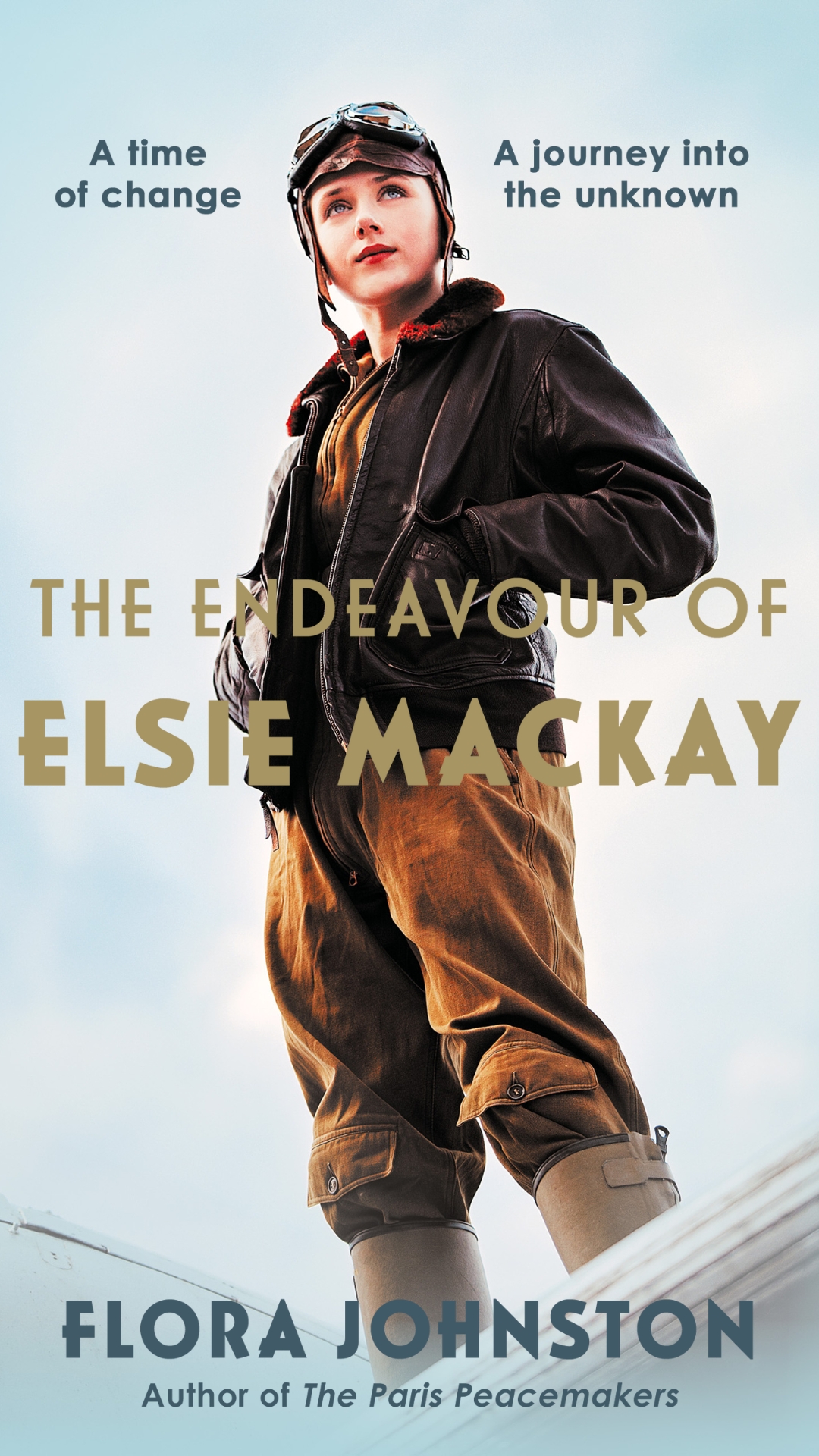
The novel is inspired by the true story of pioneering Scottish aviator, Elsie Mackay. We first met Elsie briefly in The Paris Peacemakers when, using the stage name Poppy Wyndham, she was forging a career as a film star. Now she has a new dream: to be the first woman to fly the Atlantic.
Meanwhile Stella feels trapped by motherhood and domesticity and longs to soar like her wealthy friend Elsie. Her sister Corran appears to be immersed her academic career but her secrets are beginning to unravel, while their mother Alison sets off on a Mediterranean cruise with unexpected consequences. Their hopes and dreams intertwine with Elsie’s remarkable story in The Endeavour of Elsie Mackay.
Pre-order The Endeavour of Elsie Mackay now in hardback or on kindle!

The paperback edition of The Paris Peacemakers will come out in October with a stylish new cover, and I’m delighted to share some events which are coming up. These are all free but ticketed: please do sign up and come along!
I’m so pleased to be taking part in the Portobello Book Festival again! I’ll be part of a panel on Women in Historical Fiction along Jane Anderson, author of The Paintress, and Sue Lawrence, author of Lady’s Rock. The panel will be chaired by Joanne Baird of the wonderful Portobello Book Blog. It should be a really interesting discussion. Tickets are available from Portobello Library.
Then on Wednesday 9 October at 6pm I’ll be in conversation with Helen Graham, author of The Real Mackay, at Edinburgh Central Library, chaired by Susan Elsley. In an event of interest to writers and readers alike, we’ll be talking about finding inspiration in family stories and using these to create historical fiction. Tickets are available here: https://www.ticketsource.co.uk/whats-on/edinburgh/edinburgh-central-library-george-washington-browne-room/flora-johnston-and-helen-graham-in-conversation-family-stories-in-historical-fiction/e-eqvpyq
And I’m excited on Tuesday 12 November to be celebrating the launch of the paperback in the fabulous HTA Design Studio at 75 Wallis Road, London at 6 for 6.30pm. I’ll be in conversation with Lisa Highton of Jenny Brown Associates. Tickets available soon.
Hope to see you there!
I think it’s my museum background that makes me love an object so much, particularly when I’m writing historical fiction. Recently I came across an item I’d never seen before among some family papers, and could barely believe what I was holding in my hands.
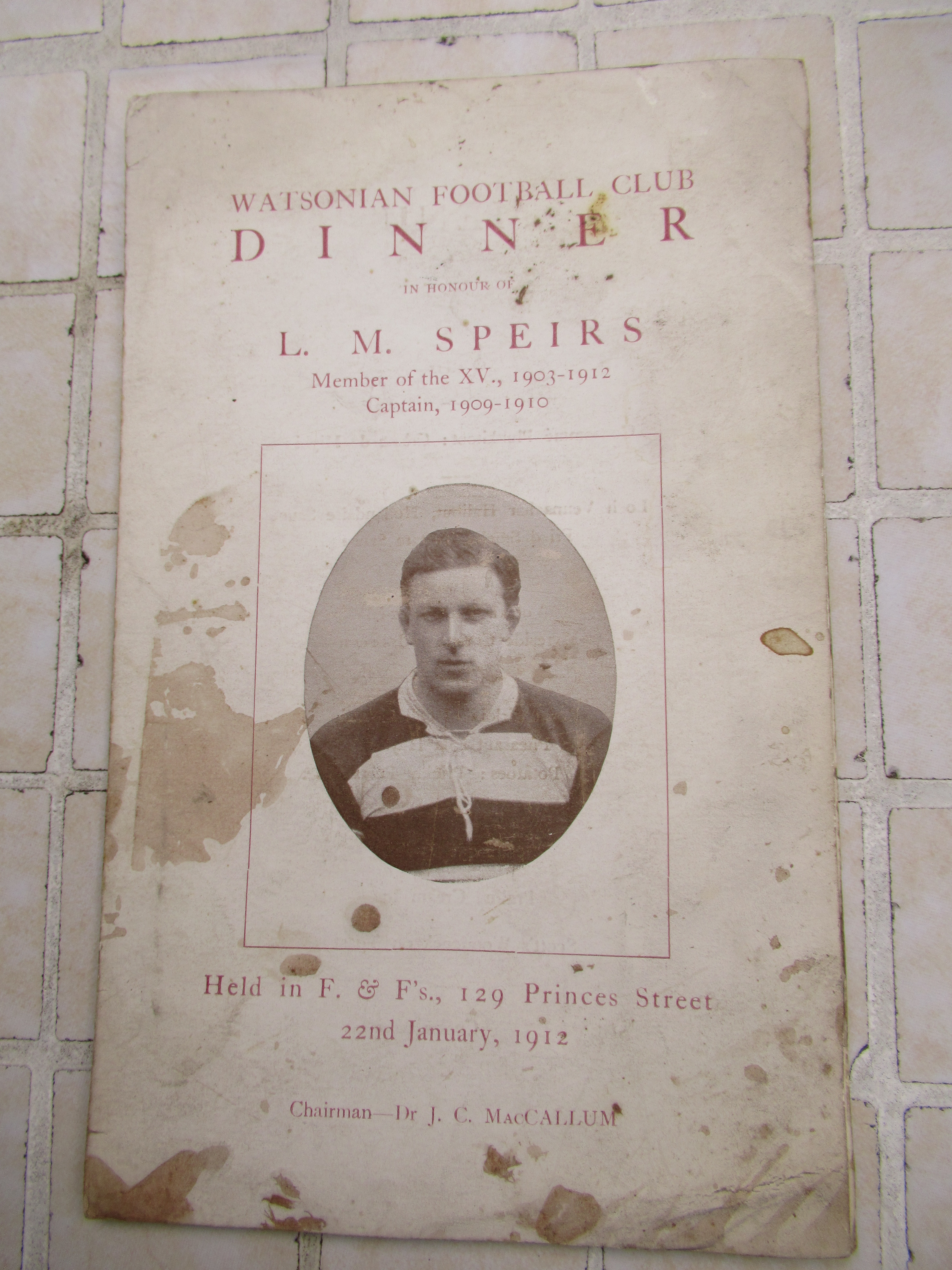

It’s the programme for a Watsonian (Rugby) Football Club dinner in January 1912, put together by a group of lads intent on having a good time, full of in-jokes and humour. Among the names included on the programme are some I came to know well as I researched The Paris Peacemakers.
One of the three main characters in The Paris Peacemakers is Rob, a young surgeon who played rugby for Scotland before the war. Rob is a fictional character, but all other rugby players in the book are men who really did play for Scotland. I researched their lives, read newspaper reports of their matches, explored what happened to them once war broke out – my spreadsheet of Scottish rugby players contains reams of information, most of which made it nowhere near the book!
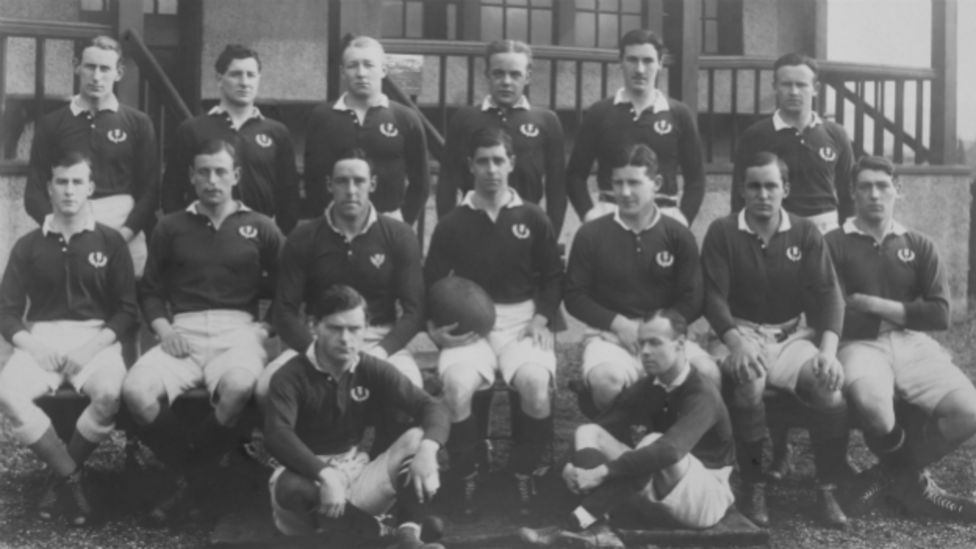
Back to the programme. On the front cover we learn that the chairman for the evening is John MacCallum. I had never heard his story until I began my research but MacCallum, considered at the time Scotland’s greatest ever rugby player, became a conscientious objector and suffered hugely for the brave, principled stance he took. The Paris Peacemakers pays tribute to him as much as it does to those who fought and were injured or killed.
‘There was one man who stood out,’ he said, and even as he spoke the buzzing intensified in his head. ‘John MacCallum. Scotland’s greatest ever captain, and hardest forward. John refused to be taken in by the lies. He stood out, and they locked him up for it.’
I skim past the menu, with such delights as ‘Roast Sirloin of Old Chairlie’, and come to the list of toasts. When I read that AW Angus ‘Gus’ is to give the toast to the ladies, a door swings wide open between the world I’m in now and the world of my book. Gus! I know him! He and Rob are together in Paris as the Treaty is signed, and Gus captains Scotland in the first Five Nations match after the war, between France and Scotland on 1 January 1920.
Gus stared at the wall, his lips moving silently. You might have thought he was praying, but Rob knew he would be planning his final words to the boys, his captain’s message. What do you say to prepare your team for the first match in six years? What do you say to the boy who knows that he’s earned his first start because the legend he replaces was blown to bits on the Somme?

The back page lists the entertainment for the evening under a heading laden with irony: During the course of the evening the following programme will be tackled. John MacCallum begins proceedings with ‘Will you love me in December’, and Gus takes on the Harry Lauder classic, ‘The Wedding of Sandy MacNab’. Other names I recognise include Jimmy Pearson and Eric Milroy, both celebrated Scottish internationalists who won’t survive the war. I know what songs they chose to sing that night. I hold the programme in my hands and I lurk in the shadows as they knock back a whisky for courage, as their mates cheer and shout and mock. Just a group of lads on a night out.
A group of lads who, because of the accident of the timing of their birth, will soon be thrust into the worst conflict the world has yet known, with devastating consequences for each of them.
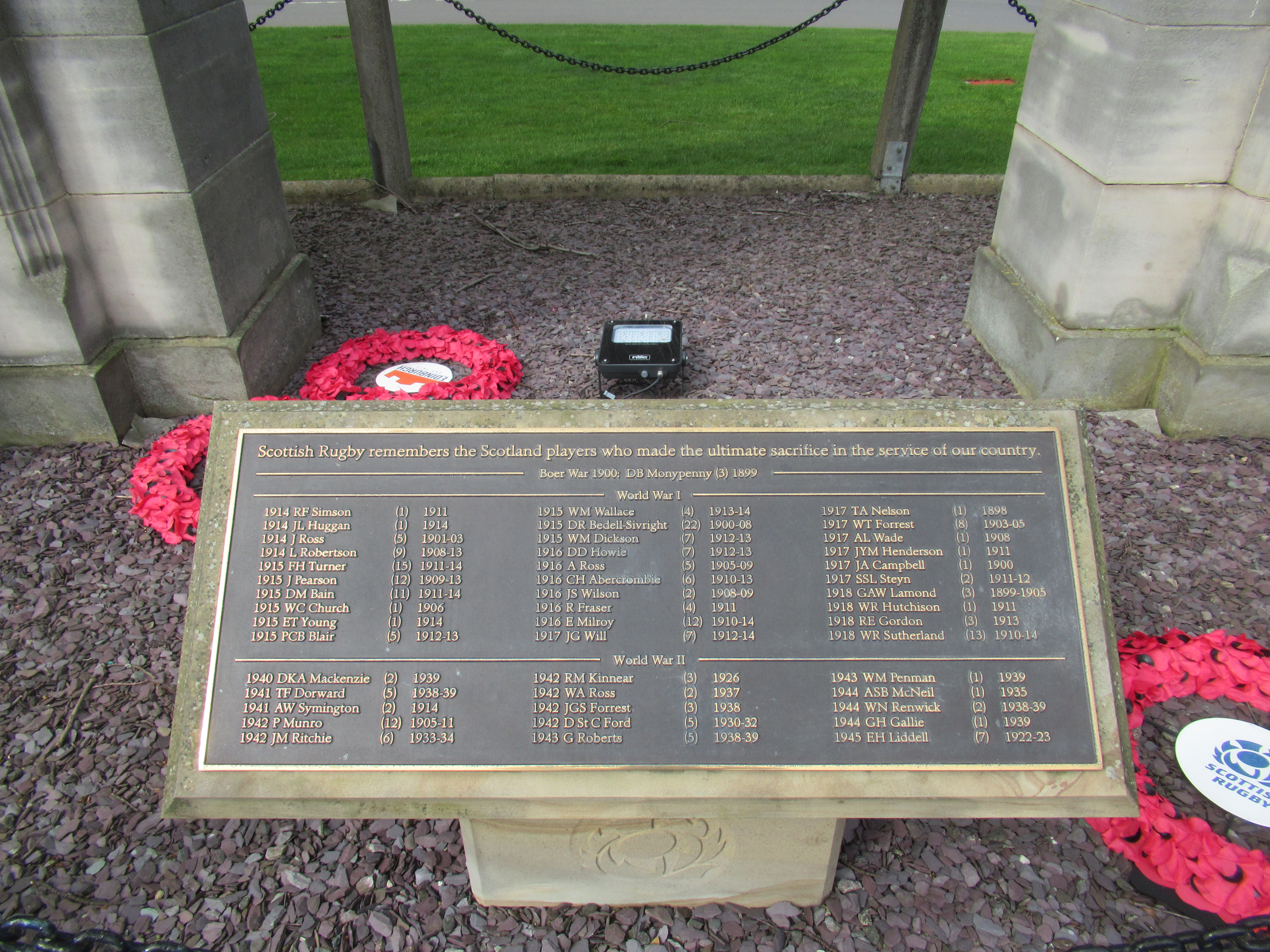

I feel again the shiver which led me to write the very first line of The Paris Peacemakers.
The only tiny mercy is that none of them knew.
The Paris Peacemakers by Flora Johnston is published by Allison and Busby and is available from Waterstones, Amazon and most other bookshops.
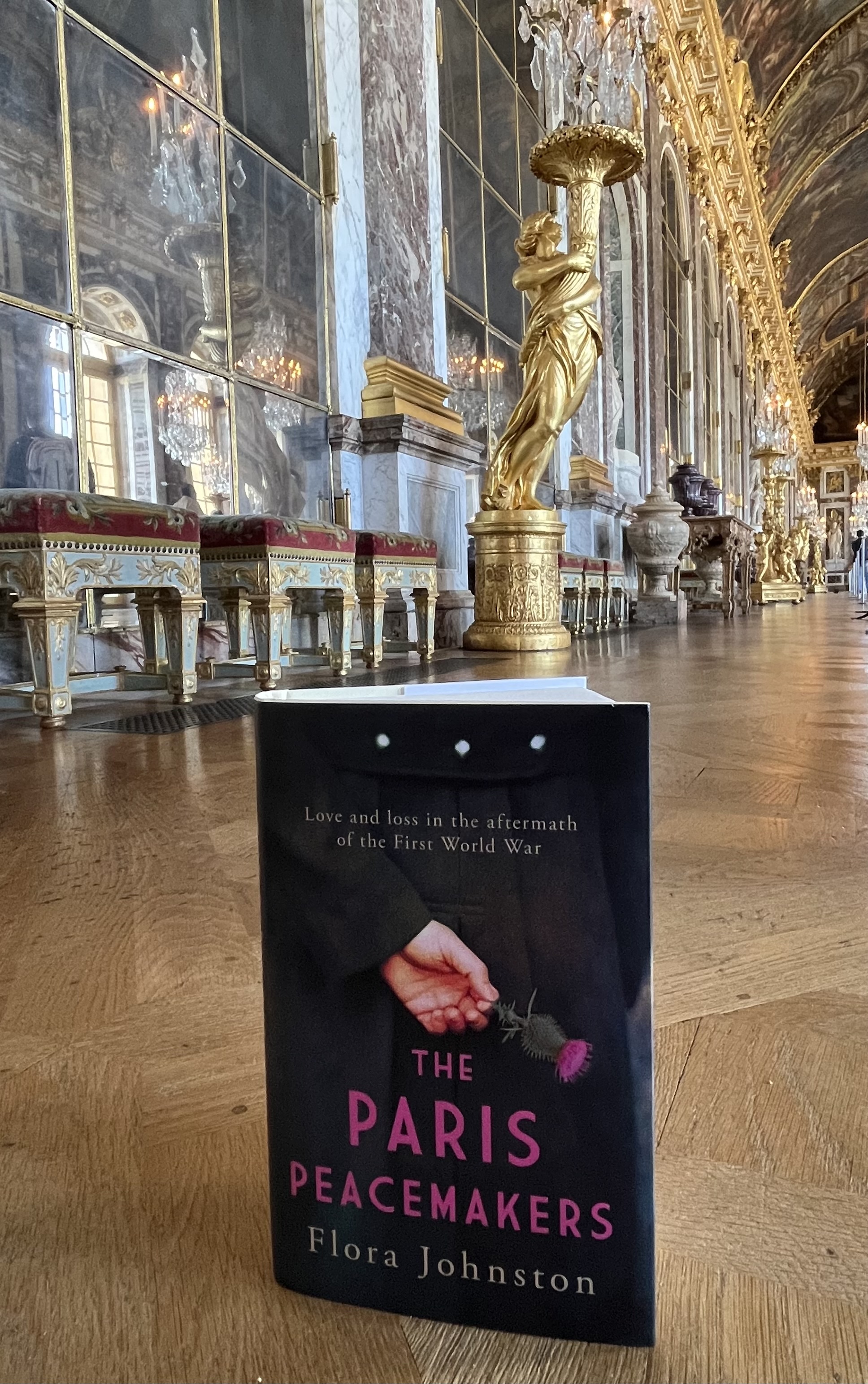
Over the last week or so I’ve posted a series of #OTD posts on X and Instagram. In 1919, this was a big week for the world, and for the characters in The Paris Peacemakers. Here’s a wee summary:
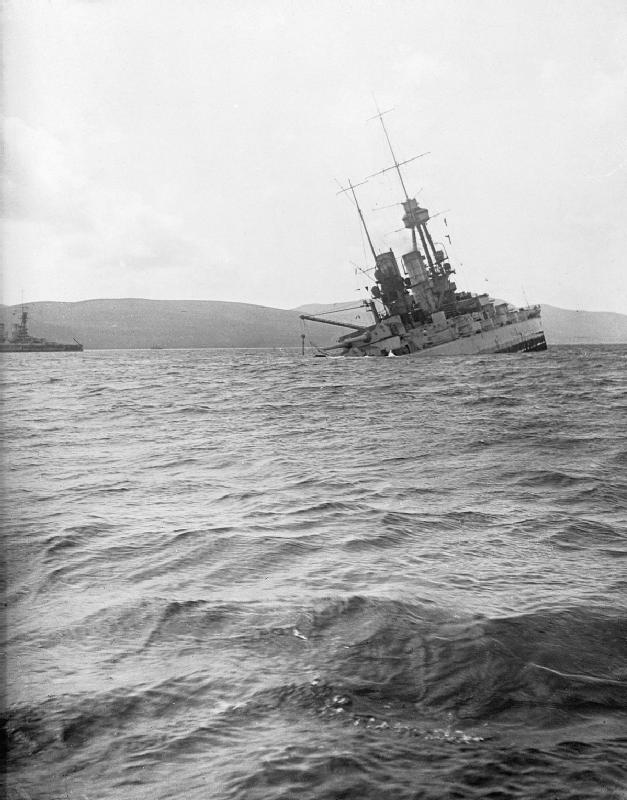


21 June 1919: In Scapa Flow the German navy sink their own ships rather than hand them over as part of the treaty being finalised in Paris. In Orkney to see if they can salvage their relationship, Rob and Corran watch the astonishing sight.
22 June 1919: Will the Germans sign the treaty? The city of Paris, not content with negotiating world peace, is concurrently hosting the Interallied Games. It’s a sporting celebration of peace and friendship although some events, like hand grenade throwing, are unexpected. Meanwhile Clemenceau and Woodrow Wilson miss the opening ceremony to plan their invasion of Germany, should the Germans refuse to sign.
28 June 1919: The Treaty of Versailles is finally signed, casting its long shadow over twentieth century history. Stella & the other typists travel out to the Palace in charabancs, wondering if the rumours that Germans will shoot themselves rather than sign are true. Can this treaty reallly bring lasting peace?
29 June 1919: The rugby tournament at the Interallied Games reaches its conclusion and Rob and Gus go along to the final. It’s the first match Rob has watched since the guns fell silent. He can barely comprehend that so many of his teammates are now dead. Will he ever be able to pull on the thistle again?
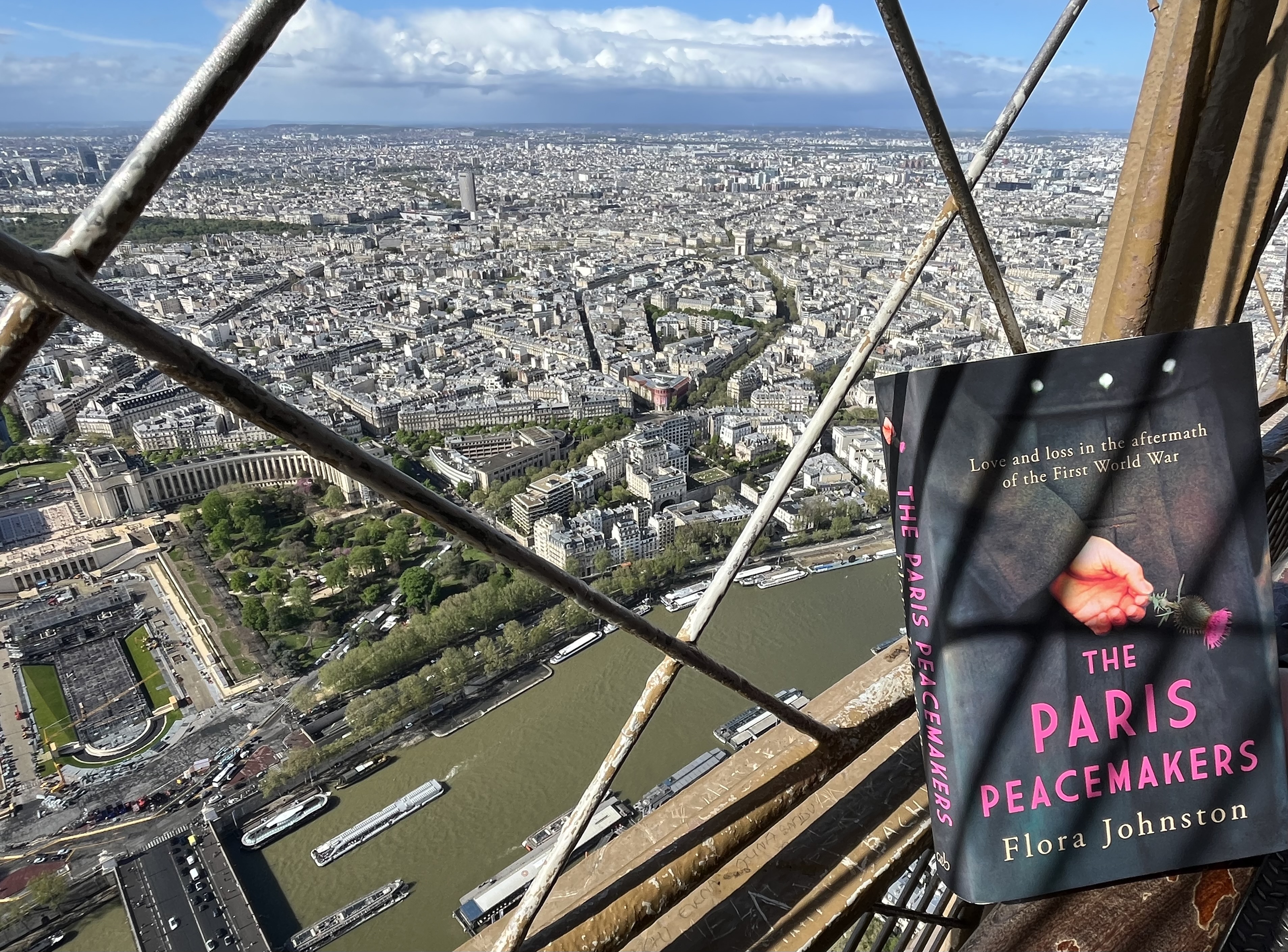
The Paris Peacemakers is available now in hardback and kindle from all good bookshops!
 Flora Johnston